Communications Channels

I was at a vendor site yesterday, discussing how they were going to satisfy our needs on four upcoming projects.  There were four people in the meeting:  the technical lead from the vendor, the product manager from our organization, a director from our organization, and myself.  Since I am the project manager, I had to take into account each perspective of each participant.  Communications grows exponentially, every time you add another person to a meeting or project.  A project manager needs to realize the complexity and manage it accordingly. The situation reminded me of a few questions that were on the PMP exam.  Communication Channels  can be calculated by using the following formula:  [N (N-1)]/2 where N equals the number of people involved.  Do not just memorize the formula, UNDERSTAND it.  Below is an illustration of the formula that should help you visualize it.
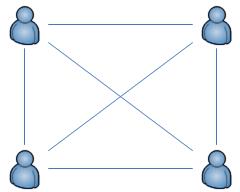
If on the PMP exam, I had been asked how many channels of communications existed in the meeting, I could either draw a picture with lines between the people or I could just use the formula.  Take my word for it, just memorize the formula and understand when it applies.

Types of Risk

For the PMP exam, know that risks can be categorized under two main types: Business  Risk of a gain or loss Pure (Insurable) Risk  Only a risk of loss (e.g., fire, flood, theft...)

When identifying and categorizing your project risks, don't forget that risks can also be positive.  Many mistakenly only list the negative.  Regardless, the purpose of risk management is to lower it.  Again, business risk can be beneficial or detrimental.  Pure risk is always detrimental. 

Cost Variance and Project Management Terms

If you're looking to take the PMP exam, there are several definitions you need to know.  You MUST know and understand the definitions listed in the table below. The exam won't come right out and ask you "What does Actual Cost mean?"  The questions are more like:  "What kind of Variance do you have on a deliverable if the Earned Value is $75,000 and the Actual Cost is $77,000?� I won’t tell you the answer. I will, however, tell you how to figure it out. Cost Variance (CV) = Earned Value (EV) - Actual Cost (AC). A negative cost variance means you are over budget. A positive cost variance means you are under budget.

Term Acronym Definition
AC Actual Cost What is the actual cost realized from the work completed.
BAC Budget at Completion How much was budgeted for the total project?
EAC Estimate at Completion What is currently the expected TOTAL cost of the project?
ETC Estimate to Complete From this point on, how much MORE is it expected to cost to finish the project?
EV Earned Value What is the estimated value of the work actually completed?
PV Planned Value What is the estimated value of the work planned to be completed?
VAC Variance at Completion How much over or under budget is the project expected to be at the end?

Scope Management

Scope Management means:

  1. Not letting others randomly expand the scope of the project without a structured change control system

  2. Constantly verifying the completion of all authorized work

  3. Ensure all changes are within the project charter

  4. Defining and controlling what is and is not included in the project

  5. Not allowing extra work or gold plating

You can read more about it on Wikipedia.  (Yes, I contribute to this definition)

Functional Management

Functional management is the most common type of organizational management. The organization is grouped by areas of specialty within different functional areas (e.g., finance, marketing, and engineering). Some refer to a functional area as a "silo." Communications generally occurs within a single department. If information or project work is needed from another department, a request is transmitted up to the department head, who communicates the request to the other department head. Otherwise, communication stays within the department. Team members complete project work in addition to normal department work. By the way, when you go to Wikipedia and read about Functional Management, know that I was the creator of the page.

Seven Leadership Styles

Leadership Recently, I've been re-analyzing different leadership styles of those in power of my former and current organizations.  I originally covered this subject back in 2008 after reading a book on the subject.  Regardless as to how I apply myself to my subordinates or how superiors react to me, everyone can be aligned with one of seven leadership styles.  Sure, I'll hear debate that there are 6, 4...  I believe this (alphabetically sorted) list covered the basics.

  1. Autocratic - To make a decision without input from others.
  2. Coaching - To provide instruction to others.
  3. Consensus - To problem solve by a group as a whole.
  4. Consultative - To invite others to provide ideas.
  5. Directing - To give authoritative instructions to.
  6. Facilitating - To coordinate or expedite.
  7. Supporting - To provide assistance during the process.

I've been in the position where those above me in the org chart were very autocratic.  We've all been there and I'm happy that situation is in my past.  Having a consensus is not always the correct answer either.  When you open the decision to be made by a group, in order to make everyone happy, you commonly just agitate everyone. Sure, leading by committee can work for some companies but I've never seen it work really well for an individual.  Make your own decisions.  I would recommend doing more directing at the beginning of a project.  Do more coaching, facilitating, and supporting later.

Managers are those who need to do things well.  Leaders are those who need to do the right thing.  For the most part, I agree with the list.  But, on the grand scale of things, I think other interpersonal skills are more important.  Both effective decision making skills and being influential come to mind.

So, what do you think?

Gold Plating

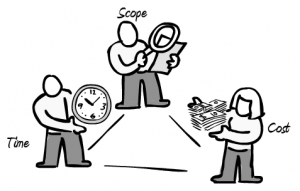
Triple Constraint

I once had a customer became highly incensed when told the deliverables he wanted were not going to be completed on time, due to a lack of resources.  He said he didn't understand why his highest priorities didn't get completed but extra features not asked for were.  When told additional features had recently become priorities he strongly disagreed.  His response was the person requesting or making the changes thought the changes were important but they were NOT.  If the changes were important, they would have been requested directly by the President of the company. (It sounds dramatic but it was true) Though there were certainly issues, at the time, as to who had authority to authorize a change, what happened was an example of gold plating.  Gold plating refers to providing the customer more then they ask for. (e.g expanded scope, functionality, higher quality)  Though this practice is based on what someone thinks the customer would like, it doesn't necessarily add any real value.  Both risk and cost will increase on the project because the requirements must still be met in the allotted time and budget.  As tempting as it might be, it is strongly recommended not to gold plate.  Try to make your customer happy by keeping your project within scope, on time, and on budget.

If your customer (or person authorized to approve a change) does indicate the change will add value, inform them of the impacts to the schedule and budget (and potentially quality and risk) and get their formal agreement to do the work.  Though it's easy to say you should not agree to make the change, the reality is you need to make the customer happy and they will make the final call.  Negotiate with them, to ensure the requested change will have a minimal impact to the current scope being completed.  In a perfect project management world, free of zombies and runaway stakeholders, there would be a separate funding vehicle and it would not impact the baseline.

PERT Formula

PERT - Program Evaluation and Review Technique.If you’re going to take the PMP exam, you MUST remember this formula.  I’ve used it countless times in the real world and it works with surprising accuracy.

Formula: (P+4M+O)/6

Optimistic time (O): the minimum possible time required to accomplish a task, assuming everything proceeds better than is normally expected. Pessimistic time (P): the maximum possible time required to accomplish a task, assuming everything goes wrong (excluding major catastrophes). Most likely time (M): the best estimate of the time required to accomplish a task, assuming everything proceeds as normal.

How does it work?

Obtain three time estimates (optimistic, pessimistic, and most likely) for every activity along the critical path.  Plug your numbers into the formula and then sum the totals.  Though people will challenge you, you WILL have a more accurate critical path estimate.

I will speak to “Standard Deviation of an Activity” and “Variance of an Activity” at a later time.   They both leverage the same values but in different formulas.