Risk is Like the Five Stages of Grief

risk

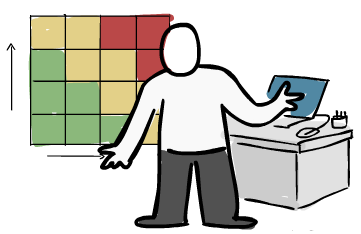
The PMBoK 4th Edition offers several risk related definitions.  I saw a trend that was very similar to the Kübler-Ross model, commonly known as the five stages of grief.  The following are a few actual risk related definitions from the PMBoK.  I hope you find them useful.

PMBoK 4th Edition

Risk - An uncertain event or condition that, if it occurs, has a positive or negative effect on a project's objectives.

Risk Avoidance - A risk response planning technique for a threat that creates changes to the project management plan that are meant to either eliminate the risk or to protect the project objectives from its impact.

Risk Mitigation - A risk response planning technique associated with threats that seeks to reduce the probability of occurrence or impact of a risk to below an acceptable threshold.

Risk Tolerance - The degree, amount, or volume of risk that an organization or individual with withstand.

Risk Transference - A risk response planning technique that shifts the impact of a threat to a third party, together with ownership of the response.

Risk Acceptance - A risk response planning technique that indicates that the project team has decided not to change the project management plan to deal with a risk, or is unable to identify any other suitable response strategy.

Kübler-Ross model

  1. Denial

  2. Anger

  3. Bargaining

  4. Depression

  5. Acceptance

Image Source: Pictofigo

Formulas To Remember For The PMP Exam

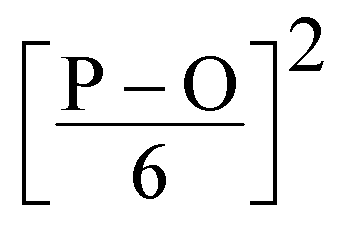
Use this formula on the PMP exam to calculate the variance of an activity

I think back to when I sat for the PMP exam and remember taking the first few minutes to quickly write down the following formulas.  It was my cheat sheet.  There was enough to think about for the next few hours and worrying if I could remember some key formulas was not one of them.  So, here is a bit of advice.  If you're preparing[1] to take the PMP exam, MEMORIZE these formulas.  The exam won't come right out and ask you to identify the correct formula for a variance of an activity. Rather, it will offer a question like:  Your current activity was pessimistically estimated at 65 hours and optimistically estimated at 40 hours.  What is the variance of the activity?  (you can use this formula for both time and cost) You can see how knowing the formula is going to make you or break you on this question.

Do yourself a favor.  Make flash cards, get a tattoo, it doesn't matter.  Commit these formulas to memory and you'll save yourself some pain and suffering (and a few points on the exam).

The Formulas

Acronym

Title

Formula

PERT

Program Evaluation and Review Technique

Use this formula on the PMP exam to calculate PERT

P = Pessimistic Estimate M = Most Likely Estimate O = Optimistic Estimate

Standard Deviation of Activity

Use this formula on the PMP exam to calculate standard deviation of an activity

Variance of an Activity

Use this formula on the PMP exam to calculate the variance of an activity

Total Float

LS - ES or LF - EF

Communications Channels

[N(N-1)] / 2

CV

Cost Variance

EV - AC

SV

Schedule Variance

EV - PV

CPI

Cost Performance Index

EV / AC

SPI

Schedule Performance Index

EV / PV

EAC

Estimate at Completion

BAC / CPI

AC + ETC

AC + (BAC - EV)

ETC

Estimate to Complete

ETC = EAC - AC

VAC

Variance at Completion

BAC - EAC

CPI

c

Cumulative Cost Performance Index

Σ

EV /

Σ

AC

TCPI

To-Complete Performance Index

Use this formula on the PMP exam to calculate TCPI

Free PM Templates and Worksheets Page Updated

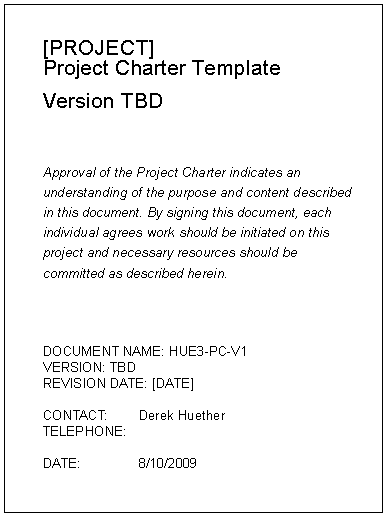
Project Charter TemplateThough I haven't uploaded any new templates today, I did fix some broken links. Thank you PJ for bringing it to my attention.  The Free PM Templates and Worksheets page has been fixed.  I understand the page should be redesigned so it's easier to see what is available.  Thank you for those who let me know when they find an issue on the site.  Feel free to just add a comment to a page.  I'll get it!
Regards,

Derek

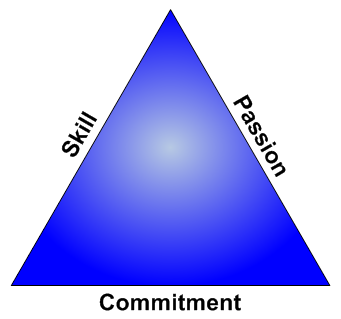
Passion + Commitment + Skill = Success

Passion Commitment Skill

I just read an intriguing post on Dan Schawbel's blog.  It was titled The Excellence Equation: Passion and Commitment. For several years, I’ve been promoting a similar “success” equation. The only component not listed in his blog post was skill. I think ANYTHING is possible if you have passion, commitment, and skill. If you’re short in one area, you can make up for it in another. I’ve worked with people that lacked a specific skill, but were so passionate and so committed, there was no way they were not going to succeed. When building teams for a project, I like to find individuals who excel in each area. I don’t want an overly-skilled team as much as I don’t want an overly-passionate team. But, when there is balance in all three areas, I’ve seen magic happen.

Mike Cottmeyer talks about scaling Scrum

On our current project, we have over 100 people across 14 Scrum teams.  The challenge?  How do you communicate between Scrum teams?  Well, that all depends. What are the dependencies between the teams? Though I could write a 1000+ word post about this, I figured I would just link to a short but informative video.  In it, you'll see Mike Cottmeyer talk about scaling Scrum and how you might have different types of scrum-of-scrums (the way you would communicate between Scrum teams).  Mike is a Product Consultant and Agile Evangelist at VersionOne.  You can read more from Mike on his blog, Leading Agile, or on the VersionOne blog, Agile Chronicles. I'm hoping if all goes well, we'll be bringing Mike to Washington DC to offer a few days of training.  I'm sure this will be one of the many important topics to cover.

Tool Of The Week: Tweet Effect

Because I feel it is important to help others, I figured I'd start doing something new.  It's not a new idea in the grand scheme of the Internet, but it is something new for me.  I'm going to attempt to promote tools, people, or businesses on a weekly basis.  I'm not being compensated accept for maybe some good karma.  I am exposed to some brilliant people and products on a daily basis.  I have to believe someone will benefit from this series.

This week will be about a product I went searching for.  I noticed I had a drop in Twitter followers and  I needed to know why.  Was it something I said?  Well, the short answer is YES.

Tool of the Week 1 TweetEffect

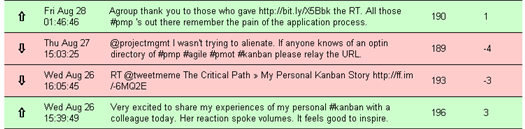
I found a product that simply states "Find out which of your Twitter updates made people follow or leave you. " It didn't require that I provide my Twitter credentials, only my Twitter ID.  It then gave a well formatted timeline of my tweets, the number of my followers, and the changes that correspond with my tweets.

I think this tool is excellent.  It provides the feedback necessary for me to change my Twitter behavior.  I discovered two possible behaviors people following me (or used to follow me) don't like.

[1] My former followers didn't like it when I retweeted my own post.  I'll admit, I was trying Tweetmeme as a new feature and that one backfired on me.  The result was 3 unfollows. In the future, if you want to retweet my posts, I welcome it.  But, I won't be doing it myself.

[2] My former followers either didn't like the appearance that I alienated someone or the fact that I had four hash tags in my tweet.   The back-story is The Triple Constraint blog had a post titled Top Project Management Twitterers.  I was included on the list and was very flattered to have been mentioned.  It was retweeted and I posted a thank you.  Unfortunately, there are a LOT of people that could have been on that list that were not.  When one of the people I follow expressed that the roll call of PM Twitterers felt like being back at school waiting to be picked in P.E., I felt like a complete heel.  I posted a semi apology and asked if anyone knew of a directory of PMs.  The result was 4 unfollows.

So, I'm here to recommend Tweet Effect [www.tweeteffect.com]to all those Twitterers who are curious about what they tweet about and how it might impact those who follow them.  The feature is free of charge.

Let me know if you found this post helpful.

Regards,

Derek

Meeting PMP Eligibility Requirements

Process Group Activities GraphWhen I was completing my PMP application, back in 2006, I recall reading the eligibility requirements and asking myself where I had the greatest gaps in my project management experience.  PMI did a good job of listing the process groups and activity "buckets" in which I could associate my time.  To visualize my strengths and weaknesses, I identified each activity provided by PMI as a process group subcategory and then associated project hours within a spreadsheet.  Though PMI had a requirement that I document experience in each of the process groups,  I had a personal requirement that I improve where my skills were lacking. This post isn't about my strengths or weaknesses, though you could assume by the graph that it would be Initiating and Closing.  It is about my identifying my experience gaps and helping you identify yours (in the eyes of PMI).  If you're a PMP or an aspiring PMP, take a look at the attached.

Step 1: Review the Process Group Activities PDF.  It will define the subcategories.

Process Group Activities PDF

Step 2: Associate subcategory hours on a project basis.  The formulas are already in the worksheet.  All you need to do is add your hours to the Project Data sheet.

MS ExcelActivity Breakdown By Process Group

Step 3: Review the Graph on the tab titled "Graph".  If you don't identify your strengths and weaknesses from the data sheet, you will certainly see them in the graph.

Best Regards,

Derek

How To Know When A Meeting Has Ended

I just read are very intriguing post by Ken Clyne on the Agile Blog, located at RallyDev.com. The post was about how problems can arise when people don't realize a meeting is over.  Ken offered one way to avoid the never-ending meeting is by having a clear signal that the meeting has ended. I could not agree more. Don't you just hate it when a meeting has ended, not everyone knows, and people just start to filter out of the area?  I've found myself looking at the meeting host and actually ask if we were done.  That is not a way to conduct a meeting.

Though I believe this applies to all meetings, the daily stand-up (daily scrum) really needs to have a clear beginning and end.  Though some may not agree with me, I like to use a visual aid like a big alarm clock.  Everyone sees the clock ticking away and know a very loud alarm is going to go off at an agreed upon time.  You see people get anxious if others are rambling on and the time is ticking away.  Think back to your youth.  Remember how you knew you were late for class because you heard that starting bell?  Remember how you knew you were dismissed from class because you heard that same bell? Let those years of conditioning motivate the team.  Though I like the visual queue, you should still say something to the team to close the meeting.

Unlike your school days and hearing your assignment is due Monday, I know I've closed meetings with So let it be written, so let it be done, Make it so and May the force be with you.

Link to the original post

Image: Pictofigo