
Passing the Test of All Tests (PMI Audit)

He who pulls the sword from the stone shall be a PMP

So, you just completed all of the paperwork, detailing all of your applicable education and work experience.  PMI has given you the green light to schedule a date to take your PMP® exam.  But what if you are audited?  Wouldn't that just suck!?

Well, you met the requirements.  PMI didn't say anything so you must be in the clear.  Time to sign up to actually take the exam.  Through a link on the PMI website, you pick a testing center in your area and find a time that will work.  You enter your credit card number and click submit.  Surprise!  Instead of getting a confirmation page, saying thank you for paying for the exam, you get a "you've been audited" screen.  What the hell!?

So, as soon as they have your money, you go into audit limbo.  The audit process has started and there are only two ways out.  [1] You withdrawal your application to take the exam.  You will get "most" of your money back. [2] You complete your audit, submit your paperwork, and PMI allows you to take the exam.

With all of the figurative threats PMI publishes about not embellishing your experience, you better not have done it!  I would compare this to going to a job interview.  Your potential employer says they like what they see.  You can continue on in the interview process, as long as you take your resume back to each of the employers you've listed and get them to sign a document agreeing you actually did the work.

What if your application is audited?

PMI answers a group of questions about this. First things first, stay calm. If you didn't lie on your application, you have little to worry about.  You should have honestly detailed all of your work experience during the application process. For every project you submitted, you're going to be sent an audit report in PDF format. (see the 3 graphics to the left)

Page 1:  What you entered during the application process.

audit_page1
audit_page1

Page 2:  Stakeholder information and a line for them to sign, agreeing you did the work that you say you did.
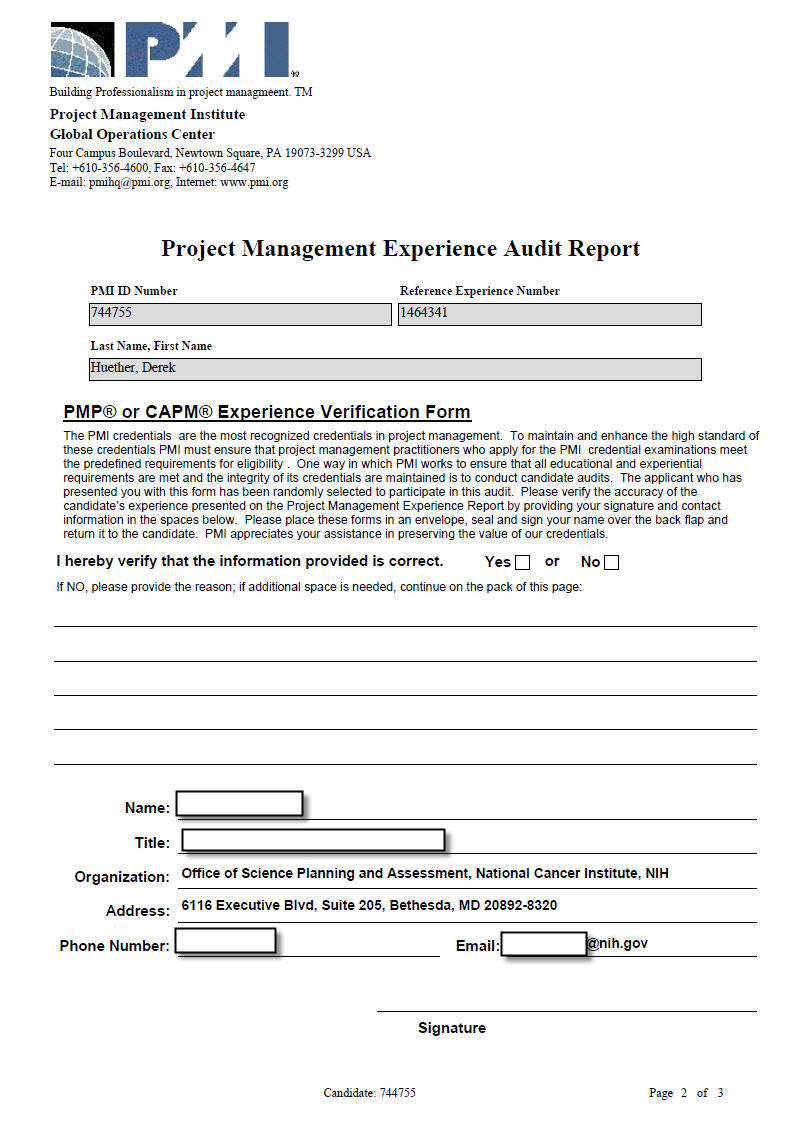
audit_page2
audit_page2

Page 3:  PMI Address information.

audit_page3
audit_page3

The pain of original signatures

For every one of these packets, you're going to need 2 original signatures.  You can have a colleague, peer, client or sponsor who has intimate knowledge of the project sign the audit.  You will then put the signed audit into an envelope (addressed to PMI), seal it, and have the same person sign the sealed envelope seam.  Once you get all of your packets signed, sealed, and signed, you mail all of the envelopes to PMI.

The actual audit by PMI will only take about a week. You will receive an email notifying you if you pass or fail.

What is my advise?

Go into the application process with the expectation of being audited.  Identify the people you want signatures from while doing your application.  Identify a backup (signature) for each project.  I spent more time tracking people down and getting signatures then I did completing the original application.  I had 20 signatures I had to get.  When budgeting the cost of the PMP exam, don't forget the cost of dinners and drinks for people who you need to track down to sign your audits.  I had to manage my audit process like I would a mini-project.

Is it all worth it?

From my personal and professional experience? Yes. Though I do believe the ever-increasing number of PMPs in the market may commoditize the certification, it's still in high demand. Regardless if you're a good PM, if you have a PMP® or CAPM®, there is an assumption you're a good Project Manager.  Because I was audited, I feel everyone should suffer the same scrutiny.  Perhaps there will be fewer paper PMPs, if they knew up front they would be audited.

Thank you to Joseph Gruber for verifying the current audit process.  He also suffered through a PMI audit.  I remember the PMI audit process being a little different, when I went though it back in 2006.  His personal experience was very helpful.

Did I miss anything specific you wanted to know?  Just leave a comment.
(Yes, that's a picture of me pulling the sword from the stone)

February PMP Certification Numbers Are In

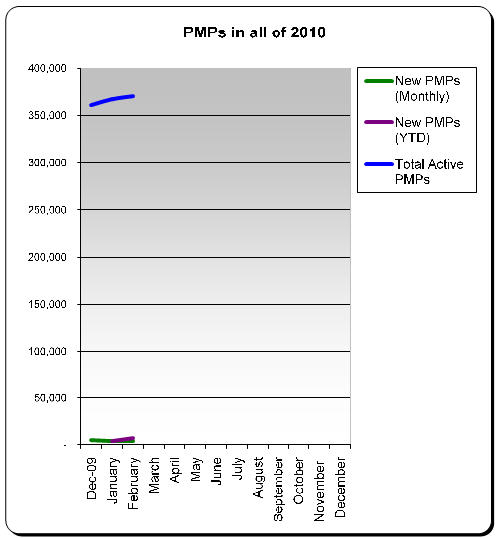
Every month I get a copy of PMI Today and I annotate 3 data points: New PMP® for the month, new PMPs year-to-date (YTD), and total number of active PMPs.  The trend continues, with the new number of PMPs down by just 1 to 3,713.  Since we only have January to include, YTD total is 7,429.  There are a total of 371,014 active PMPs. I did a quick compare to Febrary of last year.  The overall total of PMPs is up by 43,764 in 12 months.  Average that out and you’re looking at 3,647 a month.

I still predict PMI will hit 400,000 active PMP credential holders this year.  But, I'm not as bullish on them reaching 450,000 by year end.

Any questions?  Let me know.

December (2009) January February
New PMPs (Monthly) 5,403 3,714 3,713
New PMPs (YTD) 3,714 7,429
Total Active PMPs 361,238 367,619 371,014

Follow-up review of the iStudy v2.0 PMP application

The iStudy PMP v2.0 is an iPhone and iPod Touch application specifically designed to help those aspiring to pass the PMP® Exam. When I did my Original Review of the iStudy PMP® application, I was pretty happy with it.  I said for $10, go for it.  One feature I really liked was the questions were completely random.  So, each test was unique.

So, how does v2.0 compare to v1.0?

Here is what changed between the two versions:

- Key summary for each question as well as page references to the PMBOK
- The initial number of questions has been increased from 20 to 35.  All 35 questions are new and were not available in the previous version.
- Improvements to the UI (better responses; works in both landscape and portrait)
- Users can now purchase an additional 550 questions from within the application.  This version leverages a freemium model.  The free version is ad supported.  If users wish to upgrade, they get an additional 550 questions for $2.99.  (Purchase from within the app).  If you’re interested in this app, you can get it from the iTunes store or go to www.istudyapps.com.

Do I think you should get it?  Again, I say go for it! It's only $2.99 for 550 questions and this version is even better than the last.

Disclaimer: Though I recommend this product, I am not financially benefiting from this review.

Best April Fools Day Ever

On April 1, 1988, I graduated from Marine Corps boot camp.  To this day, the sights and sounds of MCRD San Diego are still vividly fresh in my head.  I joined the Marines on November 24, 1987.  One month into training, I broke my foot and was sequentially diagnosed with pneumonia (nobody said boot camp was easy).  I found myself with the decision of being discharged from the Marines or continue training after my injuries had healed.  It wasn't an easy decision. After being discharged from the hospital, I could go back to my old life (leave the Marines).  The other choice was to be sent to a medical rehabilitation platoon (MRP).  MRP is a kind of Purgatory for Marine Corps recruits.  In boot camp, your world revolves around a 12-week countdown calendar.  Every day you'd look to your fellow recruits and say "n days to a wake up".  That meant waking up from the living hell of boot camp.  If you go to MRP, you don't get any closer to day 0, until you're back in a training platoon.  I chose to go to MRP.  There I waited for almost 2 months.

I cycled back to a training platoon and my countdown restarted.  My new day 0 was set for April 1.  The day April 1 arrived, I actually thought graduating was going to be a big April Fools joke on me.  There were so many psychological games, anything was possible.   I thought for certain the Drill Instructors were going to swarm me, while in formation, and send me back to "the classroom" (a place of figurative mental and physical torture).  OK, maybe a little physical torture but that's the way the Marines were back then.  Well, they didn't swarm on me.  I graduated from Boot Camp.  I entered the Fleet as a "boot" private.

So, what's the moral of this story?  Sometime in your life, you may reach a fork in the road.  The easier path, though very attractive tactically, may not be your best decision strategically.  This critical event in my life made me the pain-in-the-ass person I am today.  Nothing, and I mean nothing, has come remotely close to the physical and psychological challenges of Marine Corps Boot Camp.  It doesn't matter if you're a project manager, an entrepreneur, or just trying to reach a personal goal.  Anything is possible if you're focused enough on the outcome.  Anything is possible if you have passion, commitment, and skill.

Graphic courtesy of Leatherneck

Performance assessment and drinking Kool-Aid

This last week, I provided a performance assessment to a subordinate.  Though I understand the necessity, I'm not crazy about doing them.  Regardless of how objective the scoring criteria is, there always seem to be someone who sees the cloud in the silver lining.  The first question I get asked is, "why do we have to do this"?  Let me break out my trusty PMBoK, as if I need the excuse. Section 9.4.1.3 (page 237) of the PMBoK, it states

the project management team makes ongoing formal or informal assessments of the project team's performance.  By continually assessing the team's performance, actions can be taken to resolve issues, modify communication, address conflict, and improve team interaction.

Though I try to be fair and balanced, I understand I sometimes must make uncomfortable and unpopular decisions.  When I completed my scoring, the results were mixed.  In some areas, this person exceeded my expectations.  In others, they fell short.  It was interesting to see the incited response.  "Why didn't I get a perfect 10!!?"  I calmly responded, because nobody is a perfect 10.  That's kind of a half-truth.  I do believe in outliers.  But, this person is no outlier.

I went over to the white board and drew a bell curve.  I then tried to explain that my scoring put her roughly in the middle.  There were areas which needed improvement and those were the facts.  Why do some people feel entitled to getting credit when credit is not due?  A percentage of people will exceed and a percentage will fail.  It's simple probability distribution.

What I didn't understand was she completely ignored the good rating and focused on the bad.  When push comes to shove, I'm the one doing the assessment.  I do believe I should explain myself.  But after that, people need to focus on themselves.  When I get assessed, I expect honest feedback, so I can do a better job.  There is always room for improvement.  Giving me 10 out of 10 across the board may make me feel good momentarily, but then what?

Don't think I'm cold and calculated when it comes to dealing with people.  I would love to give everyone good scores, but then what would that say about me?  You'd say I've been drinking some strange Kool-Aid.  When people are doing a good job, I tell them.  If people are doing a poor job, I tell them.  If you don't want an honest answer, don't ask the question.

Does anyone out there have a recommendation for an objective (versus subjective) performance scoring?  What about ideas to motivate those who do not motivate easily?

Wise, Intelligent, and Agnostic Project Management

When it comes to branding PMs, there is always going to be a title du jour.  I see project management as one of those skills that builds with time. I don't care if you are a PMP, CSM, CSSBB, or [insert certification title here].  I don't believe you can just read about a process or approach, pass a test, and then suddenly be an expert.  Perhaps that is the difference between an intelligent PM and a wise PM.  The intelligent PM reads about a project management process and it become holy doctrine.  They hide behind a process blindly and operate projects on mere faith.  The wise PM reads and learns, interacts and learns, screws up and learns.  They base their decisions on human interaction, what they've studied, and past experiences.  It's not perfect or predictable, but neither is life. I used to believe, if a dynamic enough process algorithm was created, you could manage any project based on it.  I just don't believe that anymore.

I'm not saying a Project Management Professional, Scrum Master, or Six Sigma Black Belt certification doesn't have value.  They absolutely do if you study and practice and not just pass a test.  Studying each will increase your project management intellect.

I would describe myself as a practicing agnostic PM.  It's not perfect.  But, if I take a little I've learned from each process and have a little faith (in the people I work with), I think it will provide my best chance for success.  But don't forget that it's still just a chance.

graphic courtesy of the bbp of Flickr

Sneetches and Credentials or Certifications

sneetches

I've recently discovered a new love for reading Dr. Seuss books to my son.  I can't help but see parallel after parallel to my every day life.  I guess if you write a good enough book, like Dr. Seuss, everyone should be able to identify.  My last post about Dr. Seuss and Green Eggs and Ham seemed to resonate with a lot of people.  I had to write this post because I want to know if others see what I see. This post is about the Sneetches and Sylvester McMonkey-McBean.  There are two kinds of Sneetches in this world, those with stars on their bellies and those who don't.  When reading this, I want you to picture yourself as a Sneetch and your star being a credential or certification.

Now, the Star-Belly Sneetches had bellies with stars. The Plain-Belly Sneetches had none upon thars. Those stars weren’t so big. They were really so small. You might think such a thing wouldn’t matter at all.

But, because they had stars, all the Star-Belly Sneetches. Would brag, “We’re the best kind of Sneetch on the beaches.” With their snoots in the air, they would sniff and they’d snort “We’ll have nothing to do with the Plain-Belly sort!” And, whenever they met some, when they were out walking, they’d hike right on past them without even talking.

I'm going to introduce another character into this story.  His name is Sylvester McMonkey-McBean, an entrepreneur who offers hope to the plain-bellied Sneetches by offering them the use of his star-on-machine.

Then ONE day, it seems while the Plain-Belly Sneetches Were moping and doping alone on the beaches, Just sitting there wishing their bellies had stars, A stranger zipped up in the strangest of cars!

“My friends”, he announced in a voice clear and clean, “My name is Sylvester McMonkey-McBean. And I’ve heard of your troubles. I’ve heard you’re unhappy. But I can fix that, I’m the Fix-It-Up Chappie.

However, it soon becomes clear that Mr. McMonkey-McBean is no champion of the Plain-Belly Sneetches; in fact all he cares about is making money.  He is quite happy modifying the machine to remove stars from Sneetches who want to stand apart again.

I’ve come here to help you. I have what you need. And my prices are low. And I work with great speed. And my work is one hundred per cent guaranteed!”

Then, quickly, Sylvester McMonkey McBean Put together a very peculiar machine. And he said, “You want stars like a Star-Belly Sneetch? My friends, you can have them for three dollars each!”

“Just pay me your money and hop right aboard!” So they clambered inside. Then the big machine roared. And it klonked. And it bonked. And it jerked. And it berked. And it bopped them about. But the thing really worked! When the Plain-Belly Sneetches popped out, they had stars! They actually did. They had stars upon thars!

Then they yelled at the ones who had stars at the start, “We’re still the best Sneetches and they are the worst. But now, how in the world will we know”, they all frowned, “If which kind is what, or the other way round?”

Then up came McBean with a very sly wink. And he said, “Things are not quite as bad as you think. So you don’t know who’s who. That is perfectly true. But come with me, friends. Do you know what I’ll do? I’ll make you, again, the best Sneetches on the beaches. And all it will cost you is ten dollars eaches.”

He encourages the Sneetches to continually go from the star-on-machine to the star-off-machine and back to the star-on-machine.

All the rest of that day, on those wild screaming beaches, The Fix-It-Up Chappie kept fixing up Sneetches. Off again! On again! In again! Out again! Through the machines they raced round and about again,

Changing their stars every minute or two. They kept paying money. They kept running through until the Plain nor the Star-Bellies knew Whether this one was that one or that one was this one. Or which one Was what one or what one was who.

Eventually, Mr. McMonkey-McBean vanishes once the Sneetches run out of money.

Then, when every last cent of their money was spent, The Fix-It-Up Chappie packed up. And he went. And he laughed as he drove In his car up the beach, “They never will learn. No. You can’t Teach a Sneetch!”

Fortunately, in the end, the Sneetches have no idea who is who and both Star-bellied Sneetches and Plain-bellied Sneetches learn to live together.

But McBean was quite wrong. I’m quite happy to say. That the Sneetches got really quite smart on that day. The day they decided that Sneetches are Sneetches. And no kind of Sneetch is the best on the beaches. That day, all the Sneetches forgot about stars and whether They had one, or not, upon thars.

In the project management community, I think a lot of people will recognize Sylvester McMonkey-McBean as the Project Management Institute or the Certification Boot Camps.  But, I'm certain this is not unique to my industry.  Are they there to help or are they there to make money?  I'm not going to crucify either because I have a certification.  But, just because I have 2 stars on my belly doesn't make me any better than someone with none upon thars.

What do you think?

What happens when you walk your own critical path

PMP Exam Flash Card

Last night we deployed HueCubed v1.0 to Production.  A year ago, I had an idea for a product that would inexpensively help people study for the PMP® Exam and other certifications or tests.  The result?  HueCubed. HueCubed is a web application which will display randomized flash cards.  Upon reviewing the question, you simply click on the Flip button.  The card flips and displays the answer.  You then have several buttons you can click.  If you click on skip, incorrect, or correct, the system will log your selection.  You can then, at any time, click on Check Progress.  If you click on Flip, the card flips to the other side.  If you click Back, you will navigate to the previous card.

Progress

So let's say you want to see your progress and click Check Progress.  Your choices will be broken down by categories of study.  Think of them as mini decks of cards.  There is one big deck (All) and then you have it broken down into 23 categories.  At any time, you can click one of the squares and it will return you to that card for review.  e.g. if there were 28 cards in a deck and you click on 14, you can go directly to card 14 of 28. (see image)

Anyway, I can go on an on about this product.  The idea came to me after I was asked over and over again to recommend products to help people study for the PMP® Exam.  Sure, the products are out there.  But, each one had something I didn't like or thought could be improved upon.  I wanted something Simple, Powerful, and Cost-Effective.  So, I created HueCubed.

The last year has been hard.  I went through 3 development teams before I got a winner.  I'm not demanding or anything.  It's just hard to find the right team sometimes.  I spent countless hours eating my own dogfood.  I created UI wireframes, I created fnctional designs.  I created a WBS.  I used a Kanban to manage my work.  We iterated and iterated.

HueCubed v1.0 was my critical path.  All of the required deliverables are there.  It will be a solid platform to build upon.  I hope I didn't drive me wife too crazy with the idea of this first product.  I still have a group of offerings I want to provide.

In closing, I want to quote 2 great people who inspired me to do what I did.

Jason Calacanis said “Starting is easy; Finishing is hard.”

Seth Godin wrote "Pick a budget. Pick a ship date. Honor both. Don't ignore either. No slippage, no overruns."

I had an idea on March 22, 2009, that seemed simple enough to finish.  How hard could it be?  The answer was "very".

I had a budget and stuck with it.  I gave myself 1 year to get it done or move on with my life.

I bootstrapped the effort and got it delivered.

HueCubed v1.0 went live at 11:28PM last night. Yep, March 22, 2010.