May PMP Certification Numbers Are In

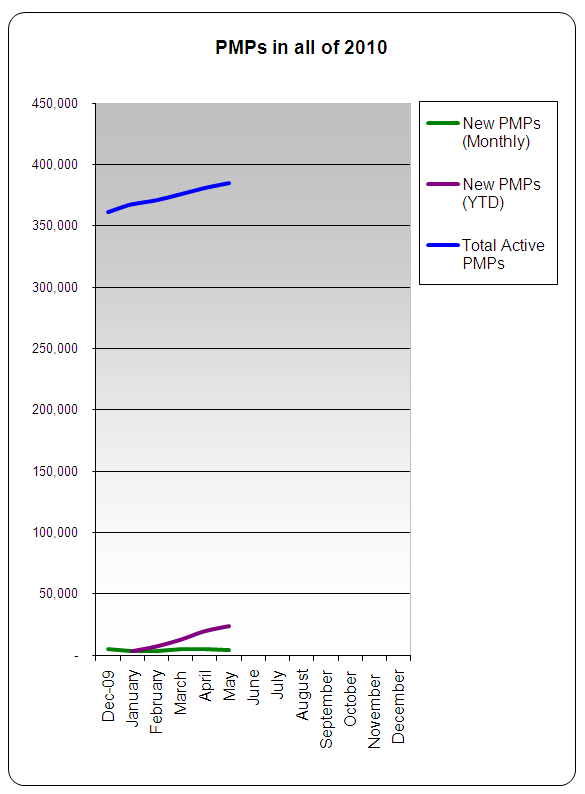
Every month I get a copy of PMI Today and I annotate 3 data points: New PMP® for the month, new PMPs year-to-date (YTD), and total number of active PMPs. This month was a little interesting because PMI stopped reporting the New PMP monthly numbers and the YTD total, opting to report just the overall number of active credential holders. This is not a problem since I have been tracking the PMP data for over a year.

The trend continues, with the new number of PMPs in May totaling 3,985. Year-To-Date total is 23,581. There are a total of 385,096 active PMPs.

The current trend predicts PMI will hit 400,000 active PMP credential holders this year.

December (2009) January February March April May
New PMPs (Monthly) 5,403 3,714 3,713 5,344 4,718 3,985
New PMPs (YTD) 3,714 7,429 12,779 19,596 23,581
Total Active PMPs 361,238 367,619 371,014 375,959 381,111 385,096

Though I'm still worried we're rapidly reaching a tipping point, I want to congratulate those 3,985 out there who passed the exam. It's no cakewalk and I recognize your efforts and achievement.

Of those 3,985, I've been in contact with several who passed the exam with the aid of my new product PMPrepFlashcards.com. Yes, I know, gratuitous plug.

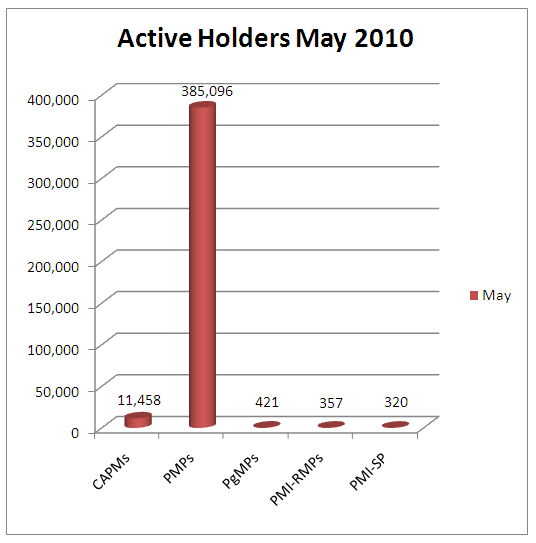
The new data PMI did include in this months PMI Today was very enlightening.  It's about the other credentials.  As of May 2010, there were 385,096 active PMP credential holders.  In comparison, there were only 11,458 Certified Associates in Project Management (CAPMs)®, 421 Program Management Professionals (PgMPs)®, 357 PMI Risk Management Professionals (PMI-RMPs)®, and 320 PMI Scheduling Professionals (PMI-SPs)®.
With the industry dominance of the PMP® credential, it makes me question if these other certifications have the staying power.  Is there a demand for them or are they just a possible revenue stream for PMI?  Will there other certifications for the other knowledge areas?  Is Certified Scope Professional and Certified Communications Professional not far behind?  If I would PMI, I would go for it.  You don't know what the market will find valuable unless you try it.
Social constraints for your meetings

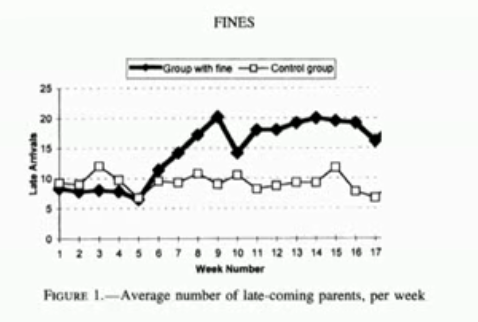
One rule that I have about meetings is it should start on time so it can end on time.  We all know that is easier said than done.  If you have a daily stand-up meeting, which is timeboxed at 5 to 15 minutes, you can not afford to have people showing up late.  They need to show up on time. But what if there is that one person on the team who does show up late... every... meeting?  Do you punish him or her?  Let's make them pay a dollar every time they are late.  Do you think that is a good idea or a bad idea?  Have you tried it?  I have.  It surprised me when it didn't change that person's behavior.  If anything, it just ensured they would be late.  Why?

By paying me the dollar, that person no longer felt obligated to arrive on time.  Everyone else, while still adhering to the culture of acceptable behavior, arrived on time.  Everyone else on the team, felt equally obligated to arrive on time because I was on time.  They felt that they owed it to me to be there on time.

So, how do you correct this negative behavior?  I like to zone in on something that makes the violator uncomfortable.  I've made them sing.  I've made them dance.  I've stopped the meeting when they've arrived late and then made them go from person to person on the team and say "I'm sorry for wasting your time".  This may sound a little over-the-top but they slighted everyone on my team.  Everyone else was there on time; they should be as well.

I'm including a link to a TED video with Clay Shirky.  You don't need to watch the whole thing.  What 4 minutes starting at 6 minutes 50 seconds.   He mentions the study A Fine Is A Price by Uri Gneezy and Alfredo Rstichini in 2000.  It is exactly what I'm talking about.  It defined the difference between social constraints versus contractual constraints.  Nothing like a research study to spice up the next meeting.

http://www.youtube.com/watch?v=qu7ZpWecIS8#t=6m50s

Always have a plan B when negotiating

choiceAB

choiceAB

Too many times people, including project managers, freeze like deer in the headlights when asked what their contingencies are.  Rather than get all dramatic, in the event you may not get your first choice, you should know what your other choices are and assign pre-qualifying criteria to them.  Be prepared to negotiate...EVERYTHING. I hate making emotional decisions.  I do make them but not until after the logical decisions have been exhausted. It doesn't matter if you're trying to negotiate a new salary or deciding where you and a group may have dinner for the evening.  You should know what your options are and negotiate the best outcome.

If given the choice between A or B, when I want C, I commonly abstain.  This frustrates people, maybe because they are used to groupthink and they are trying to avoid conflict.  Some may think I'm being passive-aggressive or an obstructionist.  Actually, if I know what I want, I just won't settle (when I don't think I have to).

The PMBOK offers a few helpful negotiation points in Section G.8.

  • Analyze the situation.

  • Differentiate between wants and needs - both theirs and yours.

  • Focus on interests and issues rather than on positions.

  • Ask high and offer low, but be realistic.

  • When you make a concession, act as if you are yielding something of value, don't just give in.

  • Always make sure both parties feel as if they have won. This is a win-win negotiation. Never let the other party leave feeling as if he or she has been taken advantage of. (I don't always do this)

  • Do a good job of listening and articulating.

Know your choices.  Don't settle.

Giving Back to the Project Management Community

To give a little back on Friday, June 24, we're giving away ten (30-day) promotional PMP flashcard memberships. These will be fully functional memberships. You'll have access to all 2,000 PMP exam flashcards. You'll have access to real-time progress. The only drawback is it will only be a (30-day) promotional membership. But, if you're preparing for the ®PMP, this is your chance to save 10 bucks! (the cost of unlimited access at PMPrepFlashcards) We all know, with the cost of a PMI membership, the PMP exam, and other preparation materials, you're going to need it. Since Twitter has been so instrumental in our success thus far, we're limiting this promotion to Twitter account holders only.

3 Simple steps Get 1 of the 10 promotional memberships

  1. Have a Twitter Account
  2. Log into PMPrepFlashcards with your Twitter Account
  3. Send us an email identifying your Twitter Account Name and we'll flip the switch

Let us know if you want us to tell others that you got a FREE 30-day membership.

3 Simple steps Get a free unlimited account or money

  1. Create a PMPrepFlashcards account (Does not require Twitter login but it's easier)
  2. Get someone else to sign up for a Premium account ($10)
  3. Have them send us an email with your account name.

Think of it as a referral fee. If you get others to sign up, and you have a PayPal account, we'll start sending you $5 for each. Don't forget, they have to send us an email with your account name.

Graphic source: Politiken.dk

Doing AB Testing

So, as you can see, we're getting a little better at graphic development.  I guess you get what you pay for.  So, if given the choice, which would you click?  We're finally at a point where the PMPrepFlashcards product is stable at version 1.1.1 and we're very happy to introduce it to new customers.  But, how do you do that?  How do you get people to a new website?  One way is to get potential customers to have ads.

Here are 2 ads that have appeared here on The Critical Path.  Through recommendation, I added my name to the ads.  Nobody knows who HueCubed or PMPrepFlashcards are.  I'm doing some A/B testing to see which is more clickable.  Is it the flashy ad or the plain ad?

Do me a favor, choose one!  By selecting number 1 or number 2, Google Analytics should tell me which is the most popular.  Who needs a poll when I can just review the Analytics?

If you want to let you feeling known publicly, I welcome comments below.

Nine Destructive Behaviours

Geoff Crane, in the time I've known him, has opened my eyes to the area of project leadership many ignore.  Geoff looks at things from a human perspective.  I know it sounds odd but many of us make objective, quantifiable calculations.  Geoff does as well but he doesn't ignore his gut feelings.  He writes about his knowledge and experiences on his blog Papercut Edge. Geoff recently wrote a series about destructive behaviors (behaviours for my colleagues in Canada) project leaders need to avoid; 9 of them in fact.  As I read each, I found myself nodding my head over and over again.  Yep, he nailed that one.  Yep, he nailed that one as well.

How did he do it!?  How did he describe situations that could have been taken from my biography?  Too bad I didn't have Geoff's book several years ago.  I could have avoided all 9 destructive behaviors.

  1. The Sack
  2. The Magpie
  3. The Deer in Headlights
  4. The Hungry Vulture
  5. The Premature Solutioner
  6. The Terrier
  7. The Wanderer
  8. The Anticipator
  9. The Reluctant Puppet

When he decided to publish the series as an ebook, I was flattered that he asked me to write the forward.  Do yourself a favor.  Read his blog.  Read his ebook.  You'll be glad you did.

Forward from Nine Destructive Behaviors

To be successful as a project leader, you need to know destructive behaviour when you see it. And there is no better tool for this than Geoff's ebook! The Latin saying, ‘praemonitus, praemunitus,’ loosely translates as ‘forewarned is forearmed’. “9 Destructive Behaviours Project Leaders Need to Avoid” is an essential read for any individual wishing to be a successful project leader.

Get a free copy here!

Let's do what makes sense

I sat in a meeting Friday afternoon to meet the new guy over at the vendor's office and give my assessment to my client.  It never gets boring, listening to rhetoric from a vendor.  They usually speak to my client, not with my client.  A few months ago, after I asked the vendor a very specific question about the sloppiness of a metric, the vendor replied  Do you have a problem with that!? Well, actually, I think both of us (the vendor and I) have a problem.  We're both here to ensure this client gets quality work.  It doesn't matter if it's a software build, documentation, or even a graph is a slide deck.  The vendor lamented and the metric actually makes sense now. The new guy, though perhaps giving us lip service, actually established himself as a bridge builder and communicator.  He said he wanted to know our concerns so we'll all be in step.  He gave us his email address and mobile telephone number, telling us not be hesitate contacting him.  When we pressured him on a request we've been demanding from the previous leadership, he said they would figure out a way to get it done.  When asked of our first steps going forward, his response was...

Let's do what makes sense.

What a refreshing response. No "let me get back to you". No "let me check with my boss".  It was a direct answer.  It was ambiguous but I thought it was acceptable considering the situation.  Compared to hearing traditional responses like "Ya, we can do that" when asked to if the vendor could make a change or deliver something, this guy actually said Let's do it.  If we can be in agreement as to what makes sense, we're golden.

At the end of the day, I don't care what they can do.  I care what they will do.  Let's hope we're turning over a new leaf.

The Pepsi Challenge of Waterfall, Agile, or Kanban

Coke-vs-Pepsi

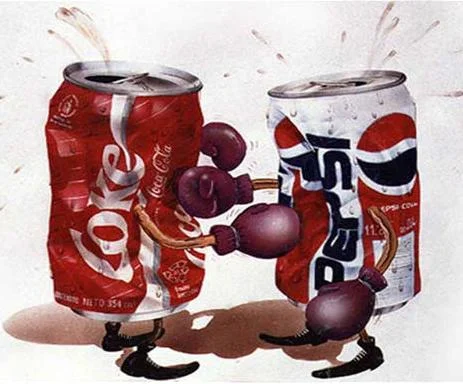
I kind of enjoy it when people get all in a huff over which soda is the best.  It's bad enough they can't even decide what to call it. Is it soda, pop, or soda-pop?  I've even heard a few refer to any brown carbonated non-alcoholic beverages as a "Coke".  I don't get that at all.  I'm going to assume these people just don't care.  All they want is a brown carbonated non-alcoholic beverage that will satisfy their thirst.  As far as soda-pop, I am the complete extreme opposite.  I drink Coca-Cola.  I don't drink Coke; I don't drink Pepsi.  If I ask you for a Coca-Cola and you ask me if Pepsi is OK, I'm going to respond with a stern but polite "No".  But, at the end of the day, I am also just looking for something to satisfy my thirst.  But, I digress. Since the Pepsi Challenge in the mid-70's, there has been another battle raging.  Let's call it the Delivery Challenge.  Regardless of what facts may be reports, detailing which approach lowers risk the most, which approach delivers the most value up front, or which approach leaves the stakeholders feeling the most satisfied, we all have our favorite.  If delivery approaches were soda-pop (yes, soda-pop) in a blind taste test, chances are we'd stick with our favorite regardless of what we may have picked.

From my own perspective, I don't believe we should be so blind to these opportunities.  We should be open to the idea that formulas can be improved and we should be open to the idea that processes can as well.

When I'm dealing with the government client on a particular contract, I use Waterfall.  We're talking Waterfall the size of Niagara Falls.  It's not that I choose this approach (drink).  It's all that is currently offered. When I'm managing my own personal projects and deliverables, I use Agile and Kanban.  I'm not saying one is better than the other!  But, when the choice is mine, I know what I like from each.  I ala carte the way I do things, so (as the customer) I get the most value while not bastardizing the original processes.

I know there are those out there who are cursing me.  They are strict Coke, Pepsi, and Dr. Pepper zealots.  Think of me as that kid down at the local Kwik-E-Mart who takes his cup and adds a little of each soda-pop in his 64 ounce cup.  It may look nasty but it sure tastes good.

...and at the end of the day, isn't it important that I just satisfy my thirst?

Image source: USAGeorge