Week of the Elephant

I'm not sure of the origin, but as I was watching an adventure race years ago, I heard an awesome quote.  One of the contestants was asked how he was able to trek a 300 mile course, navigating so many obstacles through so much adversity.  His reply was "even an elephant can be eaten, if you do it a bite at a time".   Though I try not to whip that quote out every time one of my colleagues appears stuck on a project, I do like to bring it out for special occasions.  I think this may be one of them. 3 things happened this week, that rate the reference:  Work during the day, school, and work during the night.

By day, I'm an adviser to a Federal Project Management Office.  I'm not in a position to tell government employees what they should or should not do.  It's my job to advise and support them in any way I can.  This week, they asked me to attend an invoice meeting.  This wasn't a surprise.  Upon reviewing the vendor's invoice from last month, I wasn't satisfied the Billing of Materials (BOM).  There was a lot of stuff ordered and I am very particular about asset management.  I recommended a 7 figure short pay.  I don't think it's important to be specific about the amount.  My client decided to do a 6 figure short pay.  At the 2 hour meeting, we went line by line and the vendor offered corrective actions for items I recommended not be paid.  I accepted some of their proposed corrective actions but they still need to deliver on some promised if they want all of the invoice paid.  One month down, another to go.

Our son started Kindergarten this week. We weren't sure how he was going to take to it.  Until Monday of this week, we were convinced he was going to be crying at the bus stop, wanting to say home with Mommy.  We figured he'd come around in time.  Monday arrive and so did the bus.  He ran aboard almost before we could give a hug and a kiss goodbye.  He returned some 8 hours later and ran off the bus with a big smile on his face.  The adventures that boy had!  Here it is Friday night and he's fast asleep.  One week down, 16 years to go.

At night, I find myself reading the PMBOK® or project management blogs and writing PHP, CSS, and JavaScript. Back in March of 2009, I realized I wanted to create something to help project managers on a grand scale.  That's when I started doing mockups and wireframes for what was to become the HueCubed engine and PMPrep Flashcards.  One year later we launched version 1.0.  This week I worked on 2 new jQuery elements and tonight deployed v1.2.12.  The web application has been progressing nicely and both customers and affiliates are signing up.  Though I never thought we'd get to v1.0, I now do an iterative build and deployment at least once a week.

For those interested, I still have plans for a PMPrep Exam Simulator web app and Prince2 Flashcard web app.  And yes, we're going to be doing an iPhone application.

Graphic: South African Tours and Travel

Expense of Meetings

meeting

meeting

I just came from a monthly meeting, scheduled to last 2.5 hours.  I counted 40 people in the room, ranging from administrative assistants to top executives.  I wanted to do an unscientific estimate of the cost of the meeting.  I used Meetordie (meet or die) to arrive at my total.  (Thank you to Deanne Earle of Unlike Before for telling me of the site) I plugged in a few simple values and... the meeting had an estimated cost of $17,904.  The information provided by the vendor, from my perspective, was not worth nearly $18,000.  Please realize this is a required monthly meeting. The slide deck was distributed to everyone on the project via email, allowing them to review the materials at their leisure.  They do need to be kept informed.  But, instead of going about their day, many who received the slide deck came to the meeting.  We all sat in a room as the vendor read from the slides.  Now, this was no Steve Jobs keynote address.  The vendor pretty much read word-for-word off the slides.

Just because the vendor may be contractually obligated to have this meeting, they should propose an alternative to what they're doing.  There either needs to be more value or less cost associated with this meeting.

Thoughts or comments?

Graphic: Pictofigo

Lawfulgood PMP Level 5

After reading a blog post by Dennis Stevens, I suddenly realized one of things about the family of PMI certifications that has been bothering me.  The family of credentials does not lend itself to the Dreyfus Model.  Dennis offered really compelling arguments about what does certification imply, about people who can’t or won’t earn certifications, and what he calls tilting at windmills. The Dreyfus Skill Acquisition Model, which Dennis references, identifies five stages of competence:

Novice: Rigid adherence to taught rules or plans.  No exercise of discretionary judgment.

Advanced beginner: Limited situational perception. All aspects of work treated separately with equal importance.

Competent: Coping with crowdedness (multiple activities, accumulation of information). Some perception of actions in relation to goals. Deliberate planning. Formulates routines.

Proficient: Holistic view of situation. Prioritizes importance of aspects.  Perceives deviations from the normal pattern. Employs maxims for guidance, with meanings that adapt to the situation at hand.

Expert: Transcends reliance on rules, guidelines, and maxims. Intuitive grasp of situations based on deep, tacit understanding. Has vision of what is possible. Uses analytical approaches in new situations or in case of problems.


PMI currently has 5 certifications.  You don't need to be an active PMI member (currently at 318,421) to hold one of these certification.  To get one of these credentials, you need to meet some educational and experience requirements and then pass a written exam.  Only the Program Management Professional requires a panel review.

Certification Total Active
Project Management Professional (PMP) 389,726
Certified Associate Project Manager (CAPM) 11,785
PMI Risk Management Professional (PMI-RPM) 393
PMI Scheduling Professional (PMI-SP) 327
Program Management Professional (PgMP) 436

What is missing here is some continuity between the credentials and something that indicates the level of expertise.  There is a difference between a PMP who met the minimum experience requirements and one who has been practicing in the profession for 20 years.  Would calling someone a Lawfulgood PMP level 5 with a 20 wisdom and 30 charisma help?  I'm not proposing we pull credential titles form Dungeon and Dragons, but rather something that will give the laymen an idea of experience.

Do I have an example?  I absolutely do!  Check out the International Consortium of Agile (ICAgile).  They are proposing a 3-phased, skill-based, certification.  If PMI borrowed from this model, the CAPM would be part of phase 1 (Associate), RPM, SP, and PMP would be part of phase 2 (Professional), and PgMP would be phase 3 (Expert).  PMI wouldn't necessarily have to mimic this framework exactly, but do you see how it puts it all into context?  If there would be a mighty uproar by the PMP community, suddenly being demoted to associate level, you could identify them as a PMP-1 or PMP-2, depending on which knowledge area(s) they have been certified in.

Any thoughts or comments?

Looking for clouds in a silver lining

For all of the haters and nay-sayers out there in the world, not every silver lining has to have a cloud. Regardless of what you say, I will continue to have a blind optimism of the world.  I will do what I can, with the time and budget I have.

Here's a quote for you.  I don't plan on doing this every day.  So, just enjoy it and shut up.

“Around here, however, we don’t look backwards for very long. We keep moving forward, opening up new doors and doing new things… and curiosity keeps leading us down new paths.”

–Walt Disney

Graphic: Frog Design

A PMI Dog Pile

Upon reading a piece featured on PM Hut, Certifications Don’t Make Project Managers, I was compelled to comment...twice.  So, what's the short story? I've been reading more and more articles from people who seem to be down right hostile toward the Project Management Institute (PMI). Richard Morreale, the author of the article, wrote

The Project Management Institute (PMI) and the Association of Project Management Group (APMG) are two of the biggest reasons that projects fail.

Dr. PDG added

In short, IMPO, PMI and to a lesser degree, APM and APMG have become nothing more than the AMWAY or Mary Kay Cosmetics of the project management world

Here's the long story.  I enjoyed the article, to include the comments from the likes of Robert Kelly, PMP and Dennis Stevens (fellows I admire).  I'll admit, I've been getting a little incensed recently after hearing stories of people who appeared to have gamed the system and got certification with no real education or experience other than a PMP boot camp.  But, most of this is hearsay.  I have been approached by people, asking for my help, who want the certification for no other reason than to bolster a résumé.  I do believe these cases are extremes and hopefully isolated incidents.

Based on your motivations and character, the outcomes of getting your certification can be completely different.  I got my certification because, at the time, I thought it was the only way I would be taken seriously.  I was dealing with a stakeholder who was being completely unreasonable.  She had a PMP and ignored everything outlined in the PMBOK.  Clearly, she had her own agenda.  Mine was a quest for knowledge in my profession and to hone my skills as a project manager.  This quest has exposed me to several different approaches, to include Scrum and Kanban.  I think I am a better project manager than I was several years ago because I am receptive to new ideas and approaches and don't necessarily walk around preaching one as PM dogma.

So, where am I going with this?  I think if your mind is open to it, you can learn a lot from preparing for the PMP exam.  I also think you can learn a lot from taking a level 400 class in Project Management at a University.  But, you have to be motivated by the desire to learn and satisfy your customer's wants and needs.  Don't think a certification will get you that dream job or make you a PM expert.  It will come back and bite you.  Sometimes being a PM means working on a project with specific knowledge area focus.  But sometimes you will be exposed to full lifecyle management, dealing with every process group.  Either way, it's not all textbook.

I think Dennis Stevens put it very well in his comment:

a PMP is like a recent college grad, a medical resident, or a 16-year old who just got their license. They have some situational awareness from having participated in projects, have been educated in the fundamentals and share a common language. But they are not prepared to be CEO of a business, an emergency room surgeon, or a cross country truck driver.

Some will argue that guns don't kill people, people kill people.  Just the same, PMI and APMG don't cause projects to fail.  Sometimes it's the PM, sometime it's the customer, and sometimes it's something that wasn't on your risk register and should have.  The noble thing to do is to try to fix the problem.  Mentor an associate PM.  Give a talk on your area of expertise.  Tell people how you failed on a project so they don't make the same mistake.  I think if we all put forth a little more effort, in helping each other become better project managers and leaders, the results could be transformative.


On the eve of a new phase

On this last day before our son starts his first day of public education, I look back and realize 5 years have passed in a blink of an eye. Project management can be a challenging profession but nothing can compare to being a parent. Sure, I feel guilt if I screw something up on a project, but in the end it's just money. What if we screw up our kids!? Because my wife and I figured family was more important than work (and money), my wife put her career on hold to ensure our son got the attention and nurturing he deserved. Our perspective and optimism of the future is represented in an awesome video created for the AARP U@50 video contest. You may have seen it before. It's worth the 2 minutes.

If anyone is looking for a technical writer, armed with a masters degree and years of experience, my wife may consider some part-time work. One thing is for certain, you know she has her priorities straight.

An evening in the ER

You sometimes forget how fragile life can be, until you find yourself sitting in a hospital emergency room. A few days ago, our son celebrated his 5th birthday.  My wife threw him two parties; one was with his friends and the other was with family.  We believe our adventure began at the first party.  Though the party was private, it was in a public place around lots of other people.  Within 48 hours of the first party, our son was lethargic and complaining of a headache.  He complained of being cold but was running a fever.  Next thing ya know, he was tossing his little cookies.  That's when his experience ended and my wife's began.  My wife then complained of a headache and waves of hot and cold.  The headache got worse...and worse...and worse.  Since she has a history of migraines, she took medication with the hope it would stop it.  Then she got sick to her stomach, just like our son.  Unlike our son, she didn't get better.

Sunday night into Monday morning was rough.  She didn't sleep due to the "migraine".  I stayed home from the office so I could take care of our son.  Monday night turned into Tuesday and still the migraine got worse.  But this wasn't a normal migraine and the medication wasn't stopping it.  She called her doctor and waited.  After a few hours, and her doctor not returning her urgent call, she had enough.  It was time to go to the Emergency Room.  We called a family friend, who picked up our son, and we were on our way to the next phase of our adventure.

When I think of the ER, I have thoughts of sitting in a waiting room for 6 hours with people bleeding profusely from their heads or coughing like they have tuberculosis.  We made our way to Frederick Memorial Hospital (FMH).  I have to say, I was pleasantly surprised by the service we received.  I could include a few project management analogies in here but I'll try to stick to the story.  It took about 5 minutes to check in.  (symptoms, medications currently taking, age...)  We sat in the relatively empty waiting room for about about 20 minutes before they took us to triage.  Before being called, we saw them call the oldest and the youngest in the room and someone they flew in by helicopter.  It was interesting to see the prioritized patients moving in and out of the waiting room.  While in triage, they asked a few more questions and slapped and armband on her wrist.  A nurse appeared and told us we were being taken to "Fast Track".  She escorted us through a few doors to an area I would describe as a medical cube farm.

Within an hour, she had been seen by a nurse.  30 minutes later, a physician's assistant came.  30 minutes later, my Vicodin drugged wife and I were leaving the hospital.  So, what was causing my wife this excruciating pain?  The staff believe she was exposed to a virus that has been going around.  Instead of just making her sick, it infected a cranial nerve.  The nerve was swelling, causing the pain.

I'm still a little pissed that her doctor didn't call her back until today.  Thanks for nothing!  I would give the hospital a pretty good rating on a few things.  They definitely managed client expectations.  I literally expected a 6 hour wait.  We were in and out in less than 3 hours.  They had free WiFi.  What can I say, I like my WiFi.  It helped pass the time.  They kept us informed of what was going to happen next.  I think communications is key to keeping the costumer happy.  The last part was someone from FMH contacted me via Twitter to check up on us.  Now that is a savvy hospital!

Thank you to all those on Twitter and elsewhere who saw my initial Gowalla post.  It was very nice to receive your supportive tweets.

See you all online!

Derek

Judging PMI Unfairly

new_pmps

Recently, I've been a bit vocal about my concerns of the volume of people getting the  Project Management Professional (PMP®) certification.  I often ask if quality is being sacrificed in order to certify more people.  Don't get me wrong, if being a PMP means you are a "quality" project manager, I think the more the merrier.  But, what if more PMPs means the Project Management Institute (PMI) doesn't have the necessary people to conduct proper audits?  I decided this question warranted a telephone call to PMI.  Though they would not give specific numbers, they stated

The number of audits have remained consistent over the last few years

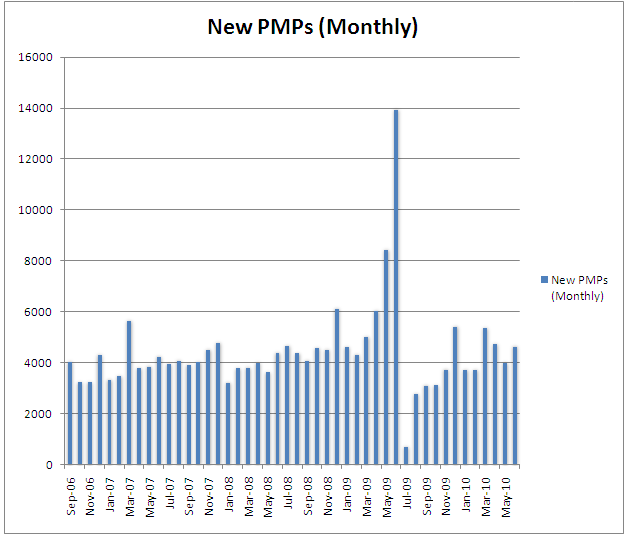
Ah-ha!  Just the incriminating statement I was expecting, to support my theory!  Clearly the increased rate of people getting certified would mean a lower percentage were being audited.  Since numbers don't lie, I went back as far as I could and compiled the monthly PMP certification rate.  September 2006 was the earliest (easily accessible) date I could find.

Once I charted all of the data to date (June 2010), I was left scratching my head.  With the exception of June and July of 2009, the rate has been relatively consistent.

Average certifications per month (2006-2010): 4,401

Average certifications per month (2010): 4,350

Highest certification rate (June 2009): 13,920

Lowest certification rate (July 2009): 689

In reality, the average number of people getting the PMP certification is down in 2010.

Have I judged PMI unfairly?  Is the quality of the certification the same as it ever was?