Outdated Success Criteria

I know this is going to probably get me some "hate" comments.  It seems like if I write about anything but a zombie, that's what happens. But I do like to write about topics that make people stop and think. Think of this post a bridge between a historical project management and futuristic project management.  Let's think about success in both an objective and subjective way.

I'm seeing more and more topics about the measurement of success.  Geoff Mattie just wrote a post over at the PMI Voices site, titled Can Agile Conquer the Physics of the Triple Constraint?

Geoff refers to Triple Constraint and states

The "iron triangle" as some refer to it, defines three pillars: cost, scope and time. It asserts that you have to prioritize the three with an understanding that trying to have all of them at the same time compromises quality.

I applaud Geoff in his zealousness and hope this works for him and hit customers.  Being his blog post is on the PMI website, I want to point out the the iron triangle is not in the PMBOK.  Rather, on page 6, it states

Managing a project typically includes... balancing the competing project constraints including, but not limited to Scope, Quality, Schedule, Budget, Resources, and Risk.

I remember a few years back, when taking the PMP exam, I had a question about typical project constraints.  The answer was not limited to 3 or even 4 "pillars".  So, where am I going with this?

triple-constraint

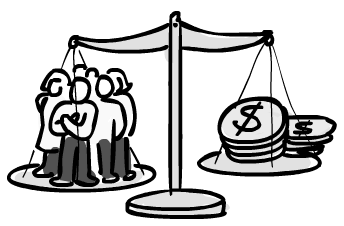
I'm curious why people continue to measure the success of a project, merely on the basis of an iron triangle.  I think this concept is outdated and perhaps created by a project manager to help an executive understand project management at a 100,000 foot view.  I am also curious why many continue to use the Chaos report, (which leverages triple constraint) as the de facto report of industry success or failure.  I am not debating that it has historical significance.  But, I am questioning if it should be the way of measuring project success.

Jeff Sutherland has a blog post about the happiness metric.In his post, he mentions Tony Hsieh of Zappos.  I recently read the book Delivering Happiness by the Zappos CEO.  Again, what's my point?  Perhaps the Chaos report should introduce happiness or customer satisfaction at part of its success criteria.

Too subjective you think?  I think not!

I recently saw a presentation by Sanjiv Augustine as part of the VersionOne AgileLive Webinar Series

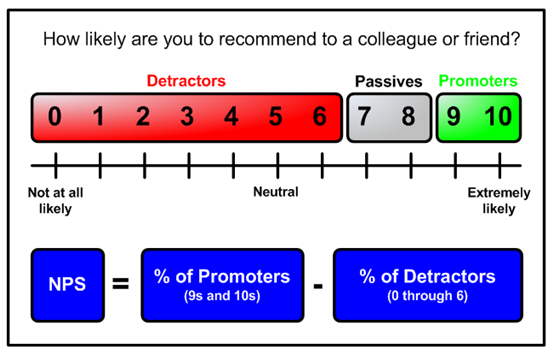
One of the concepts presented in Sanjiv's presentation was a NPS (Net Promoter Score) metric.  Think of it as a customer satisfaction or "happiness" metric.
NPS

NPS is based on the fundamental perspective that every company's customers can be divided into three categories: Detractors, Passives, and Promoters. By asking one simple question — How likely are you to recommend [Company X] to a colleague or friend? — you can track these groups and get a clear measure of company performance through its customers' eyes.

So, what is the Zappos NPS?  In a YouTube video of Tony Hsieh at the NPS Conference  (1-26-09), Tony said Zappos offered random email surveys that resulted in an 83% NPS and phone surveys resulted in a 90% NPS.  Though they lose money on some of their customers, they are an overwhelming success.

Do you believe the Standish Group Chaos Report should include NPS to define success? Are the original classifications outdated?

Black Friday & More

Black Friday has come and gone.  Thanksgiving is rapidly becoming a distant memory.  The TSA horror stories are rolling in.  I spent the better half of a week unplugged.  How about you?  Did you get any good deals?  Did a TSA agent touch your junk? We traveled to Bristol Tennessee to spend Thanksgiving with my wife's side of the family.  It was just a six hour drive.  It gave me some time to read a book on Scrum (I really enjoyed that) and think about my goals for the next year and beyond.

What I really enjoyed was talking with my nephews.  The two topics we covered?

  • What do I REALLY do?  What IS project management and what is Agile?
  • The zombie apocalypse
  • If you want to take a hard honest look at yourself, talk with a 19-year-old who is actually listening and asking hard questions.  One of my nephews really made me think about things.  We also debated which would be better in a zombie apocalypse, unlimited plywood and nails or unlimited ammunition.

    I'm going to have to save these topics for later posts.  But, a man half your age certainly has a different perspective on the world and it's worth listening to.

    Like the images?  Find them at Pictofigo

    Random Act of Kindness

    My family and I figured we'd do something a little different this last weekend and went to see ICE! 2010 at the Gaylord National Resort.  But, this post is not about Dr. Seuss or Ice or the resort.  This is about a random act of kindness. The thought is fresh in my mind, mainly because I just finishing Delivering Happiness, the book by Tony Hsieh of Zappos. One of the passages referred to delivering random acts of happiness, which was very similar to acts "of kindness" from the book and movie Pay it forward.

    So, what happened?

    With a little bit of time to spare, before going to the ICE attraction, my son and I were going to ride a small train ride inside the Gaylord Hotel.  As we stood in line, we happily chatted about getting to go on this ride.  When we got to the front of the line, the attendent asked for our tokens.  Tokens?  Nobody said anything about tokens!  She pointed to a small machine off in the distance.  We were supposed to go see ICE! in about 20 minutes so I knew our schedule was getting pretty tight.  My son and I ran over to the machine.  On the machine was the the message

    Tokens $2.  Machine takes $1 or $5 bills.  NO CHANGE

    I looked in my wallet and found two $1 bills and some $20's.  I thought for a second and then realized we were screwed.  I looked into his eyes and broke the news to him.

    Buddy, we're going to have to come back.  I only have enough for you to ride.  I can't go with you.  Do you want to ride the train by yourself?

    I saw his eyes well up as he began to shake his head.  "No, Daddy, I want you to go on the train with me!"

    I responded that I was sorry but we'd have to come back after I got some change.  Perhaps we could ride the train later, after the exhibit, if there was time.  I spent the next 15 seconds trying to explain to my son that the machine did not take $20 bills.  A woman then walked up to me, reached into her purse, and handed me two $1 bills.

    You two go have a fun train ride.

    My son and I both said thank you to her and I added I didn't have change.

    Don't worry she said, go have a good time.

    So, off we went and had a good time.  I look forward to paying it forward.


    No, I’m Saying…

    I was in a contract negotiations meeting for several hours yesterday.  The most notable quote came after the customer was asking for the basis of estimates for the scope of work being proposed. I think both the vendor and customer could have done a lot better if they had just valued customer collaboration over contract negotiation.

    I felt like I was watching a first-time buyer at a used car dealership.  When the sticker price is in the Millions of dollars, it becomes a very interesting game of poker.  As usual, my job was not to negotiate.  It was merely to observe and advise.

    Vendor: You're saying the LOE is too high.

    Customer: No, I'm saying I want you to justify your LOE.

    Like the image?  Find it at Pictofigo

    And the Winner is...

    Elizabeth Harrin!

    Congratulations, Elizabeth and her blog  A girl’s guide to Project Management, for taking home the prize at the ComputerWeekly IT Blog Awards 2010, in the category of Project Management.

    This is the 3rd year in a row Elizabeth has won in this category.  Take that as a hint people.

    Go read her blog!

    Like the image?  Find it at Pictofigo

    (Zombie) Customer Service

    I'm currently enjoying Delivering Happiness, the book by Tony Hsieh of Zappos.  In the book, his approach to customer service reminds me a lot of what Seth Godin wrote about in his book, Linchpin.  For those looking to map this to an activity in the PMBOK, I see this falling under Manage Stakeholder Expectations (Executing and Communications).

    In any case, I can relate to my intent to communicate directly to people as people, not as mere customers, vendors, or colleagues.  Every day, I see people act as though they have no free will to make a decision.  They ignore what is right or wrong.  They act like they need permission to be honest and humble. They act like...wait for it...zombies!  Yes, zombies!

    I recently sat in a meeting and heard how the vendor screwed up.  I'm talking completely-their-fault nobody-else-to-blame screwed up.  When confronted by the customer, their reaction was "I'm sorry you feel that way about [this].  I respect how you feel."

    My reaction?  [expletive] YOU, man! I don't care if you respect how I feel or not.  And don't try to feed me that Dr. Phil line about me owning my own feelings!  What I want to hear you say is "I'm sorry we screwed up.  I will do whatever I can to make this right."

    Another scenario that comes to mind was my wife contacting a credit card company about something.  The customer service rep was painfully unprepared to talk to a human being.  They could not deviate from a script one word without needed to talk to a supervisor.

    Thank you for calling.  We appreciate your business.  Can we interest you in buying our credit protection plan? [my wife complaining] Oh, I'm sorry, can I put you on hold while I discuss this with my supervisor? [5 minutes later....click]

    People, you want to provide great customer service?  Empower your customer service representatives.  Vendors, you want to provide great customer service? Empower your teams to admit when they screwed up and offer to fix it, not just cover it up.

    I've always seen the best performance from my teams, when they knew what we needed to do but were not being told how they needed to do it.  I believed they would make the right choices for us all to reach our goals.  Those of you in the Agile community get this already.  Empower the team and communicate with everyone as much as possible.  Don't just communicate.  Talk to them.

    So, as I step down off my rant soapbox, I want you to take a look at the Zappos core values (listed below). They actually remind me of the 4 values, 12 principles of the Agile Manifesto or Agile community as a whole.

    Zappos core values

    1. Deliver WOW Through Service
    2. Embrace and Drive Change
    3. Create Fun and A Little Weirdness
    4. Be Adventurous, Creative, and Open-Minded
    5. Pursue Growth and Learning
    6. Build Open and Honest Relationships With Communication
    7. Build a Positive Team and Family Spirit
    8. Do More With Less
    9. Be Passionate and Determined
    10. Be Humble

    If you had 10 core values for your project or team, how would you refine this list?

    Like the image?  Find it at Pictofigo


    Know Agile when I see it

    know_it_see_it

    I got all fired up today when I read some pretty outlandish statements by a company claiming it "helps through an innovative project management and development tool known as Agile Methodology" and they went on to write "Agile is based on a project management methodology known as SCRUM" I haven't heard something like that since someone told me Al Gore invented the Internet (urban legend). Thank you to AgileScout, who wrote the original post titled Agile is NOT a Methodology.  At last count there were 19 comments linked to the post.  Head over to the AgileScout blog and get caught up.

    So, what IS Agile and what is NOT?

    To answer that, I’m going to take a little liberty with Justice Potter Stewart’s opinion in Jacobellis v. Ohio 378 U.S. 184 (1964)

    I shall not today attempt further to define the kinds of material I understand to be embraced within that shorthand description ["Agile"]; and perhaps I could never succeed in intelligibly doing so. But I know it when I see it, and the project involved in this case is not that. [Emphasis added.]

    The fun part is knowing what Justice Stewart was really talking about.

    Like the image?  Find it at Pictofigo

    Identify Stakeholders (& Zombies)

    The Program Management Body of Knowledge (PMBOK) would have you Identify Stakeholders at the crossroads of the Initiating process group and the Communications knowledge area.  Basically, what the Project Management Institute (PMI) is trying to say is you should be identifying all of the people who are somehow related to the project.  Who holds a stake in the success or failure of your project?  You should complete this activiy at the beginning of your project lifecycle. This isn't bad advise.  It doesn't matter if you're a Project Management Professional (PMP) or an Agile practitioner.  The idea here is to lower the risk of having someone, who may be for or against your project, from disrupting things.  You have to accept that everyone has different and unique motivations.  Know your sponsor, product owner, stakeholders...zombies.  Zombies!?  Of course.  Once you identify everyone even remotely associated with your project, try to understand their motivations so you will be able to build relationships.  But look out for the zombies.  They won't listen to you and just do what they want.  Don't pass judgement on them.  Zombies are zombies.  They're going to do whatever they want and you and everyone else is just going to have to deal with it.

    Today I was in a meeting with a zombie.  Everyone in the meeting appeared to have the same opinion of the topic at hand. Everyone, that is, but the zombie.  The topic itself really isn't important.  But it was basically a room of people against one zombie.  You may start to ask yourself what the zombie must be thinking.  Seriously, it's an exercise in futility.  Just make sure you know who they are early on and make some contingency plans.

    So, remember kids, identify stakeholders (and zombies) early in your project.  Start building relationships with the people.  Find out what motivates them.  Know who are the zombies!  Take appropriate action, either by buying large quantities of plywood to board up doors and windows to the office or get some brain flavored mints.  If you can't keep the zombie away, the least you can do is freshen their breath.

    Like the image?  Find it at Pictofigo