Gingerbread Crime Scene

After a horrific crime scene at school nearly left our son traumatized for life, I think a better stakeholder management strategy could have been used. About a month or so ago, our son and his classmates all made little paper gingerbread men (and women).  They were all so proud of their creative achievements.  All was well in the world, until they returned to their classroom one day to discover the little gingerbread people were gone.  Nothing was left but some glitter (gingerbread blood) on the floor.

The story they were told was a leprechaun and fox had broken into the school and captured all of the gingerbread people.  I can't remember at this point where the story came from.  One of our son's friends went so far as to say he saw the leprechaun chasing the little guys and gals.  Don't you just love the imagination of the 5-year-old?

Unfortunately, this left some of the kids very distressed.  They didn't know the big picture.  We, as the parents, did.  What actually happened was the gingerbread folk were mailed all over the country to friends and family.

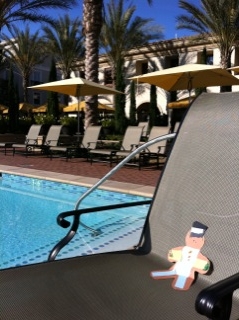
Photos were taken and, about a week ago, there was a return of the the Gingerbreads.  Our little man went to visit a family friend in California.  Mr. Gingerbread made some friends, took in the sites, did a little lounging, and even wrote our son a letter.

Hello Jacob!

WOW, what a fun week I’ve had here in California!

Upon landing at the airport, I rented this really cool car and went for a nice drive around the Orange County area. This area has so many nice beaches, parks and shopping centers! The city I stayed in is called IRVINE.

I did not know that the weather could be SO nice and warm during the Fall/Winter season! I was happy to be able to enjoy some sun and get a nice tan by the pool!

The day I arrived it was 80 degrees here!

The traffic in California is very heavy, but I got to learn the roads and freeways pretty quickly!

I also got a chance to visit a city called San Juan Capistrano and toured the historical MISSIONS.

Now it’s time to go back home and see you and all my friends again!

Gingerbread Man

So what is the Project Management hook?  When you're busy planning project activities, put yourself in the shoes of the stakeholder or Product Owner.  Are they going to react positively or negatively to your plan? You should have individual Stakeholder Management Strategies identified.  Though our son was near tears by the idea of a leprechaun and fox breaking into his classroom and killing off Mr. Gingerbread, we were there to be supportive and convinced him the outcome wasn't so dire.

Did you see the leprechaun killing Mr. Gingerbread and his friends?

Did you know that gingerbread people are known to be very fast...faster than foxes and leprechauns?

Though it all worked out in the end, I wouldn't recommend trying this on a Kindergarten class.  The gingerbreads could have easily left notes saying they were all going on vacations and avoided all of the drama an carnage.
Pictofigo Premium & Agile Scrum

The Sprint - Male ScrumMaster

The Sprint - Male ScrumMaster

A few months ago, I partnered with Pictofigo, which provides high quality free hand drawings for Agile and Scrum proponents, tradition project managers, professionals, presenters, developers, web designers...  The list of people and groups which can benefit from these free drawings goes on and on.  Why use a Pictofigo drawing?Basically, if you need a drawing and the usual clip art just isn't going to cut it, Pictofigo could be a nice solution for you.  The count of free drawings is currently over 700 and growing.

So, what is new?  It's called Pictofigo Premium.  Pictofigo Premium, a brand new service, offers high resolution drawings for download and use.  These are print-ready graphics.  At launch, there are four premium drawings ready for download with more on the way.

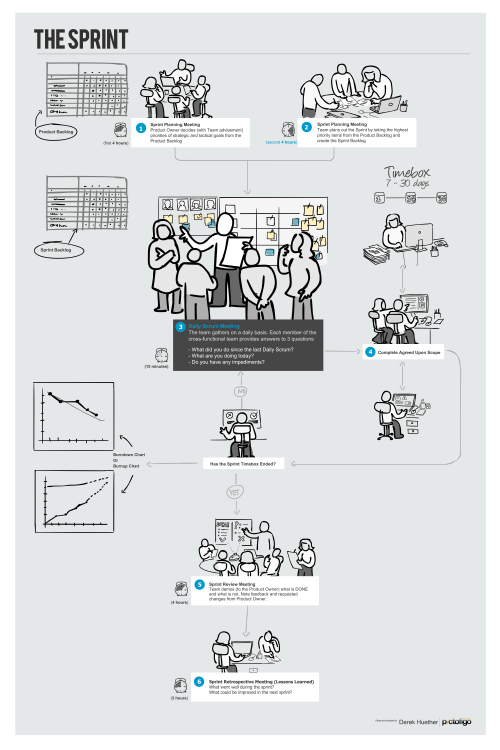
If there is one thing I've learned, it's to offer visual aids to help communicate information.  That and they cover unsightly holes in the wall.  As a result, I've partnered with Pictofigo to create one-of-a-kind Agile Scrum posters.  Our first poster titled THE SPRINT will be offered in both male and female ScrumMaster versions.

The Sprint

Perfect for dressing up any shared workspace. THE SPRINT (Male ScrumMaster) captures each of the Scrum Roles, Meetings, and Artifacts in an easy to follow workflow format. It doesn't matter if you're a chicken or a pig, you and your team will love this. This version depicts a male ScrumMaster with his team.

Large Poster (Size:34.5" x 23") Get it now for just $24.99

Small Poster (Size: 20" x 13") Get it now for just $19.99

Mini Poster (Size: 17" x 11") Get it now for just $14.99

But what if you want to make more posters for yourself and your team and don't want buy one poster at a time?  What if you want to make this your desktop wallpaper or put it in your next PowerPoint presentation?  Well, you can get the same high resolution file used to create the poster directly from Premium Pictofigo!

Get The Sprint (Male ScrumMaster) in 300DPI

Get The Sprint (Female ScrumMaster) in 300DPI

Don't forget to check back really soon! We'll be linking to the The Sprint (Female ScrumMaster) poster and also Scrum Roles (Male and Female ScrumMaster) posters

PMI Statistics through Nov 30, 2010

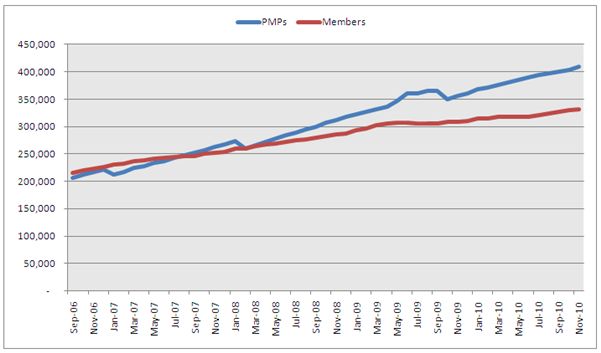
The November Project Management Institute (PMI) statistics are in.  The PMI now has over 409,159 active Project Management Professionals (PMPs) and 331,697 members. So, what's new? It looks like November was the best month in 2010 for those getting their PMP.  The one bit of data I took note of was the PMI membership numbers.  Over the last year, the data being displayed in PMI Today has changed.  It used to be, you could see how many new people got their PMPs.  The Fact File now shows only Total numbers of each credential.  It does, however, still show New (PMI) Members.

pmp_nov30

The January 2011 issue to PMI Today (page 5) indicates there are 8,502 new members.  In fact, there is an overall increase of just 1,696 members.  6,806 PMI Members chose not to renew their membership in November.  Unfortunately, based on the data, it appears people value the PMP credential more than the PMI membership.  Perhaps the PMI needs to adopt a free-mium model.  I think PMI should offer memberships for free or at a greatly discounted rate and then charge to maintain credentials or find other revenue streams.

Jan

Feb

Mar

Apr

May

Jun

New PMPs (Net)

3,714

3,713

5,344

4,718

3,985

4,630

Total Active PMPs

367,619

371,014

375,959

381,111

385,096

389,726

Total PMI Members

314,721

315,106

317,962

317,787

317,989

318,421

Jul

Aug

Sep

Oct

Nov

Dec

New PMPs (Net)

3,687

3,965

2,681

3,161

5,939

Total Active PMPs

393,413

397,378

400,059

403,220

409,159

Total PMI Members

320,388

323,220

327,180

330,001

331,697

Source:

PMI Today

TPS Report

TPS Report
TPS Report

After my little diatribe titled "Project Management Theater" I had a few days to think about the less than stellar status report provided by the vendor to my customer.  The more I thought about it, the more I realized the vendor did nothing to meet the unique customer needs.  The attitude was Well, you asked for a status report. This shows status. I'm a firm believer that you need to understand who your customer is and then provide status reporting to meet their needs.  Even when using a burndown chart for a team, I usually don't show that to a C-Level. I understand that C-Levels (CEOs, COOs, CTOs...) are looking at the business more strategically.  For that reason, I offer my 50,000 foot view of the project or program.   Two years ago, when I arrived at this PMO, I looked at their Metrics Plan.  One of the things that was missing was a summary graph or chart for the Federal Senior Executives (SES). What you see above is one graphical indicator I provided to them.  What you do not see in the screen-grab is the associated data, which I made available on subsequent pages. I'd like to thank Sam Palani over at Around the CHAOS for inspiring me to write this post. His post How Worthy are Your Status Reports nailed it.

Feel free to download a copy of my original (TPS Report) template Total_Project_Status_Template

Zombie Leadership

I just had an hour long conversation with a colleague about leadership.  We both agreed when you're working under the authority of a good or bad leader, you know it.  We also agreed that we would rather deal with a bad leader with a mission than have a complete absence of leadership. If you are working toward a goal, and you realize (on your own or from the assistance of others) that you're going in the wrong direction, you make a correction and get back on track.  You rely on leadership to guide you in the right direction.  Even leaders who are the worst of egoists have a vision and turn that into a mission. Unfortunately, that vision and mission may include throwing you under a bus along the way.

If you read my post on servant-leadership, you saw the I represented leadership on a grid.  On the far left, we had egoism.  On the far right, we had altruism.  If we added zombieism to the group, you would see it off to the left of the chart.  Zombieism shouldn't really be on the chart because it is that absence of leadership.  But, we still need to put it into context.

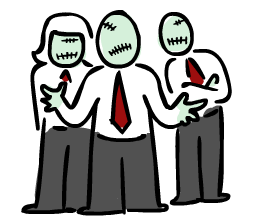
Zombieism: When a zombie acts solely to feed itself.  You can find zombies exhibiting this orientation at every level of an organization.  The zombie thinks that it is a leader of a hoard but is a destructive force because it makes no leadership decisions, good or bad.  It merely feeds.  It mere exists.

Next we have different styles of leadership

7 Traditional Leadership Styles

  1. Autocratic - To make a decision without input from others.
  2. Coaching – To provide instruction to others.
  3. Consensus – To problem solve by a group as a whole.
  4. Consultative – To invite others to provide ideas.
  5. Directing – To give authoritative instructions to.
  6. Facilitating – To coordinate or expedite.
  7. Supporting – To provide assistance during the process.

7 Zombie Leadership Styles

  1. Anti-Autocratic - To not make a decision without input from others.
  2. Anti-Coaching – To not provide instruction to others.
  3. Anti-Consensus – To not problem solve by a group as a whole.
  4. Anti-Consultative – To not invite others to provide ideas.
  5. Anti-Directing – To not give authoritative instructions to.
  6. Anti-Facilitating – To not coordinate or expedite.
  7. Anti-Supporting – To not provide assistance during the process.

If you look at your boss, your boss's boss, or your boss's boss's boss, and they delegate ALL of their authority to others, it does not make them a good leader!  It makes them a zombie leader.

Like the image? Find it at Pictofigo

Project Management Theater

tsa

tsa

After hearing public outcry over all of the "junk" grabbing going on at Transportation Security Agency (TSA) checkpoints, I heard the resurfacing of the term "Security Theater".  I'm not certain if TSA "gets it".  If you are going to take true action to help fix issues, you need to treat the cause and not a symptom.  Have a shoe bomber?  Make everyone take off their shoes.  Have someone wearing baggy clothes wear a bomb onto a plane, spend millions of dollars to see beyond the baggy clothes.  Without telling you what I did, I bypassed both the new full-body scanners and the TSA pat down in two major airports within the last few weeks.  Certainly, I didn't want to deal with either so I was happy.  The problem I have, as a stakeholder, is a lot of money has been spent and the issue still exists.

Imagine if that happened on your project?

I see Lessons Learned meetings or a Retrospectives as opportunities to help you refine your processes.  You see what works and doesn't work.  You find out the root causes and then you make changes.  You refine.

Today I witnessed what I call Project Management Theater.  The vendor loves to use Gantt charts.    On a program level, both the customer and vendor follow a more traditional waterfall process.  At last count (5 minutes ago) the "integrated" schedule had 5,954 lines.  (Internally, I use a backlog and Kanban) Within seconds of reviewing this monster schedule, I could point out improper work decomposition, improper work package mapping, description inconsistencies, improper use of preprocessors or successors and the list goes on.  If your customer prefers the use of Gantt charts over Burndown charts, I'm not going to argue with them.  Whatever the culture will demand, you have to work with it.  But, the problem here is these are just charts.  They are only as good as the data driving them.  When the customer asked me today what I thought of the split view the vendor provided (WBS/Gantt chart), I was blunt.  I hate it.I added, everything that needed to be reviewed at the meeting could have been presented either as a milestone report or backlog.  Instead, we spent most of our time trying to locate activities and get statuses on each.  On top of that, the schedule provided had not been updated in two weeks.  Therefore, we had to ask over and over again if certain activities had been completed.

If you're going to commit time and money for a support activity, please make sure the resulting "thing" has some value.  At the next meeting, I expect the Gantt chart to go the way of the dinosaur.  I'm advising the customer to request a milestone report from the vendor (instead of the WBS/Gantt Chart).  In the end, I want to ensure the vendor is reaching agreed upon milestones.  Currently, the customer is so distracted by all of the inaccurate details of the schedule, they forget to ask the hard questions about the milestones.

Eliminating the Gantt chart is not going to solve the problem.  Next week, I'm going to show the executive team a Kanban of the milestones.  Let's see if they find more value in that.

Like the image? Find it at Pictofigo

One of My Resolutions

When PM Bistro asked if I would write a blog post for them, I was happy to oblige.  You can read the original post here.  For a little background, I was asked to write about a particular work-related goal I have for 2011.  I actually have several (goal) resolutions for 2011.  I keep them on my Personal Kanban so I can be reminded of them daily.  Because they are so big, I consider them Epics.  I then break them down into "actionable" stories.  Anyway, here is the blog post.  I hope you enjoy.


When asked to think about a particular work-related goal I made for 2011, I knew it would be easy to list but harder to explain. It’s common to say “how” or “what” you’re going to do. It’s a whole other thing to say “why” you’re doing it.

The goal I have is: To articulate the values, principles, and methods of the agile community to the traditional project management community.

Why: I’ve been working in the Industry for some 15 years. I’ve seen and been involved in the best of projects and the worst of projects. Over time, I’ve seen more and more methods defined and practiced. I’ve seen people in our profession leverage these methods in the hopes their projects would be successful. It is my fundamental belief that all project managers and leaders should know all of the options available to increase the probability of project success.

How: About 5 years ago, I read the Agile Manifesto. Though it was written for software development, I discovered I could leverage some of the principles it defined in other areas. I then discovered the agile community. These progressive thinkers spoke less of maintaining the status quo and more of introducing new ways of doing things or refinement of the old. Though there are “agile” processes to follow and disciplines to uphold, many in the traditional project management community seem to be unaware of them.Some still think agile lacks both process or discipline. I hope to change that. I plan to tweet, blog, publish, speak, and mentor at every opportunity.

What: I had the pleasure of attending the PMI North American Congress in Washington DC this last year. Though I saw a very strong visual representation from the Agile Community of Practice, when I spoke to the random attendee, they had no idea what Agile was about. As I interact with both new and seasoned professionals of our Industry, I want them to know how agile can work in concert with their traditional methods. I want to see more projects succeed.

Like the image? Find it at Pictofigo

Servant-Leadership

I have a very distinct leadership style.  Those who I work for will attest to this.  I'm not talking about superiors.  I'm talking about subordinates.   In order to help build a culture I am proud of, I uphold altruistic principles.  I am a servant-leader.

Servant-leadership is a philosophy and practice of leadership, coined and defined by Robert Greenleaf. Upon doing my research, I read that Greenleaf felt a growing suspicion that the power-centered authoritarian leadership style so prominent in U.S. institutions (of the time) was not working. In 1964, he took an early retirement from IBM to founded the Center for Applied Ethics. Yes, 1964!

When representing ethical leadership on a grid (see above), the graphic should help put into perspective who leaders are and what leaders do. Egoism: When a person acts to create the greatest good for himself or herself.  You can find people exhibiting this orientation at every level of an organization.   When the organization and its employees make decisions merely to achieve individual goals (at the expense of others), they lose sight of a larger goal.

Utilitarianism: The idea that the moral worth of an action is determined solely by its usefulness in maximizing utility or minimizing negative utility.  The focus is to create the greatest good for the greatest number of people.  In Star Trek II: The Wrath of Khan, Spock says "logic clearly dictates that the needs of the many outweigh the needs of the few."

Altruism: The opposite of egoism, a person's primary purpose is to promote the best interests of others.   From this perspective, a leader may be called on to act in the interests of others, even when it runs contrary to his or her own self-interests. In Start Trek III: The Search for Spock, Kirk says altruistically,   "Because the needs of the one... outweigh the needs of the many."

Larry Spears, the head of the Greenleaf Center for Servant-Leadership for 17 years, identified ten characteristics of servant-leaders in his 2004 article Practicing Servant-Leadership. The ten characteristics are listening, empathy, healing, awareness, persuasion, conceptualization, foresight, stewardship, commitment to the growth of people, and building community.

Unlike leadership approaches with a top-down hierarchical style, servant leadership instead spawns collaboration, trust, empathy, and the ethical use of power. At heart, the leader is a servant first, making the conscious decision to lead in order to better serve others, not to increase their own power.

The objective is to enhance the growth of individuals in the organization and increase teamwork and personal involvement.  Exhibiting servant-leader qualities tends to give a leader authority versus power.

Are you a servant-leader?