Looking to place a Budget Analyst in the DC area

Though it looks like there are no jobs to be had, they are out there. If you're a budget analyst and looking for work in College Park, Maryland, here are the job requirements: +10 years of experience with project management and acquisition management with engagements in the financial, information technology and government agencies' procurement cycles of major acquisitions. Effective management of the earned value management system, source selections, and logistics of a major system's life cycle. Strong background in Microsoft Project Professional and MS Web Sharepoint environment to build-out and to maintain a networked Master Integrated Schedule that is resource loaded and integrated with multiple project files. DoD Acquisition Certification Level III and wInsight/Risk+ knowledge is preferred and is highly recommended.

If you're interested, make a comment to this post with your email address attached. I won't make the comment public. It just gives me an opportunity to securely identify interested applicants. I'm not the person doing the hiring. I'll just make sure your resume gets to the necessary people.
Project Duration Forecasting

I've had a subscription to a trade rag called CrossTalk (The Journal of Defense Software Engineering) for a few years now. I've read the articles but none really got my attention and kept it. In the December 2008 issue, there is an article about comparing Earned Value Management Methods to Earned Schedule. It was written by Walt Lipke of the Oklahoma City Chapter of PMI. Now that I'm working on a very large government project, this article really sparked my interest. If you're working in a government PMO or on a government project, I recommend you give it a read. The author did a really good job of using real project data and also did an excellent job comparing EVM methods to the Earned Schedule (ES) prediction technique.

If you're new to Earned Value Management or still studying for your PMP, this may make your head hurt a little. If PVcum, EVcum, and BAC are in your daily vocabulary, you'll enjoy it. Article Link

Earned Value Management (EVM)...the basics

Should all projects or programs utilize Earned Value Management? Short answer: No Long answer: The industry standard for project control systems described in American National Standards Institute (ANSI) EIA-748, Earned Value Management Systems, must be implemented on all projects with a total project cost (TPC) greater than $20M for control of project performance during the project execution phase.

Earned Value Management (EVM) is a systematic approach to the integration and measurement of cost, schedule, and technical (scope) accomplishments on a project or task. It provides both the contractee and contractor(s) the ability to objectively examine detailed schedule information, critical program and technical milestones, and cost data.

In layman's terms, it quantifies the estimated value of the work actually accomplished.

Using Project Management Templates

At my last engagement, there was a lack of matured documented process.  I'm all about process. If you have good process, quality results will follow.   People sometimes don't understand that if a documented process does not provide value to the project, you should not do it.  Consistently use proven templates, processes, and methodologies to refine your project management approach. Templates are mere tools in a toolbox.  Again, only use the ones that provide value to the project.  I once had a Product Manager voice her frustration because she was told to complete ALL of the project templates in the repository, after the project was in a later phase.  My response was to weigh the cost (time) of completing the templates against the benefits gained by them.  The benefits are traditionally lower risk or higher customer satisfaction.  In this case, it was neither.  If anything, there should have been Lessons Learned or Postmortem document that would have identified the gaps or overlaps of the documentation.

To assist readers of my blog, I'm going to start uploading templates I've used at previous engagements.  They are free of change and will fall under public domain.  You'll find them by selecting Free PM Templates or locating the link in the right navigation menu.

PMI Code of Ethics and Professional Conduct

I pride myself in the fact that I'm a very honest and hard working manager.  I define the Huether Triple Constraint as Passion, Commitment, and Skill.  I'm passionate about what I do, I'm committed to the organizations I work for, and I rely on my skills and the skills of others to be successful. As part of commitment, ethics and professional conduct should always be considered.  One of the questions I always ask myself before making a leadership decision is "Is this good for the project and our organization?"  No, I don't work for Initech and this isn't Office Space.  This is a valid question and there will be several questions on the exam that deal with ethics and professional conduct.

I recommend reading the PMI Code of Ethics and Professional Conduct. Even if you don't take the PMP, every good project manager will learn from it.

Triple Constraint

Triple Constraint

Triple Constraint

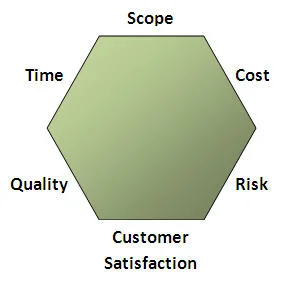
With Project Management, you must understand that EVERY project has constraints.  Unfortunately, project managers tend to ignore this and it will come back to haunt them time and time again.  Constraints include time, scope, cost, quality, risk, or any other factors that will limit what your options are when managing a project or deliverable. "Triple Constraint" is a term that originally included time, scope, and cost.  Newer definitions include customer satisfaction, risk, and quality.  If you're preparing to take the PMP® exam, include both the original and newer definitions.  Sextuple constraint just doesn't quite role off the tongue. I try to stress to stakeholders every time they try to expand scope that it will directly impact the other constraints.  If you expand the scope, you will either have to expand cost or time.  If you don't expand either of these two constraints, you're going to increase risk and lower quality.

You'll first read about constraints in section 1.3 of the PMBOK®.  PMI will only refer to them as constraints at that time.  Y0u'll find them referenced at other locations within the PMBOK as project constraints.  What you will not find in the PMBOK 4th edition is an actual definition in the glossary.

What a Project Management Plan is not

On a daily basis, I hear managers, directors, and executives referring to the MS Project file as "the project plan".  I must frustrate a lot of people because I refuse to call it that.  I refer to it as the activity list and Gantt Chart.  Some PMPs call Gantt charts "bar charts" but I am one of those people who still calls a cotton swab a Q-Tip.  Either way, if you refer to the MS Project file as an activity list and bar chart, you're on the path to passing the PMI exam.  If you're still convinced it's a project management plan, I can almost guarantee you're not going to pass. A project management plan, as defined in the in the Project Management Body of Knowledge (PMBOK) is "A formal, approved document that defines how the project is executed, monitored, and controlled.  It may be summary or detailed and may be composed of one or more subsidiary management plans and other planning documents.

I usually refer to my "plans" as a project management packet.  I include my signed charter, the communications plan, risk plan, resource plan...  I keep them in a central packet and also a central virtual folder for easy access. 

And that's all I have to say about that.