GQM: If you can not measure it, you can not improve it

GQM Paradigm

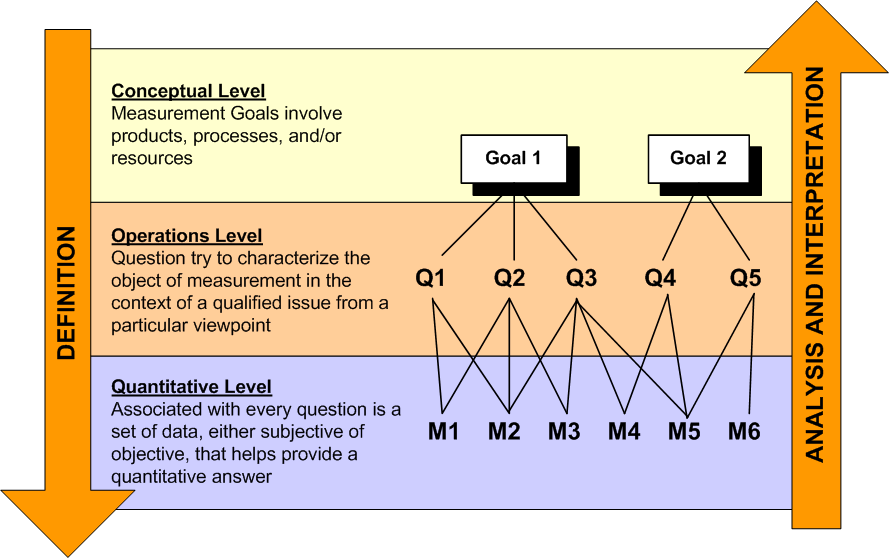
In trying to determine what to measure in order to achieve the goals of a project, a Goal-Question-Metric (GQM) paradigm should be used.  It can actually be applied to all life-cycle products, processes, and resources.  The GQM paradigm is based on the theory that all measurement should be [1]goal-oriented i.e., there has to be some rationale and need for collecting measurements, rather than collecting for the sake of collecting. Each metric collected is stated in terms of the major goals of the project or program. [2] Questions are then derived from the goals and help to refine, articulate, and determine if the goals can be achieved. [3] The metrics or measurements that are collected are then used to answer the questions in a quantifiable manner.

Image based on Basili, Caldiera, and Rombach "The Goal Question Metric Approach", 1990

Here is an example of the GQM in action:

Goal 1 (use this 4-step process to shape a goal) [1] Purpose [2] Issue [3] Object (process) [4] Viewpoint

Goal 1 [1] Maintain [2] a maximum level of [3] customer satisfaction [4] from the Help Desk user’s viewpoint

Question 1 What is the current help desk ticket trend?

Metric 1, 2, 3, 4 Number of help desk tickets closed Number of new help desk tickets % tickets outside of the upper limit Subjective rating of satisfaction

As the great Lord Kelvin once said, "If you can not measure it, you can not improve it."

10 Helpful Steps to Submit PMI PDUs

I'm in the process of helping a group in the PMO make their submissions for PMI Professional Development Units (PDUs).  All PMPs need 60 PDUs during a CCR cycle so don't put it off until the last minute.  In this case, they all participated in a workshop.  If you want to collect PDUs, you're going to need some kind of evidence.  It might be a program agenda, copies of a publication, transcript, certificate, registration form... do I need to go on?  This is actually for you in the event PMI audits you.  In this case, participating in a workshop, the evidence is not required to actually complete the PDU request online. Know your PMI ID #, Cert #, and Last Name on file with PMI.

Step 1: Log into the PMI homepage. A Membership Status box will appear in the left navigation menu with the following data: PMI ID No.: Member Since: Expires:

A Certification Status box will also appear in the left navigation menu with the following data: PMP No.: Earned: Renewal Date

Within that Certification Status box, at the bottom, is a link titled "View PDUs" [http://tel.occe.ou.edu/pmi/PMI_Member/PDUlogin.php3]

Step 2: Select the "View PDUs" link Step 3: Enter your ID#, Cert#, and first four letters of your last name Step 4: Select the "PMI PDU Self Report Form" radio button Step 5: Select the "Login" button to continue Step 6: Select the Activity you wish to claim  ("2e" for participating in a workshop) Step 7: Complete the entire form (know the knowledge area and process group) Step 8: Select the "I Agree" checkbox and the "Continue" button Step 9: Review for accuracy Step 10: Select the "Submit" button

Go back and review your Online Transcript in a few days to verify your submission was successful Repeat Steps 1, 2, and 3

At Step 4,  select "PMI Transcript" radio button Step 5: Select the "Login" button to continue to your Online Transcript

See, it's not as hard as you thought!

Critical Path is Back Up

As my eyes rolled to the back of my head last night, waiting for the server to finish configuring, I hoped my website transition plan was going to work.  Yesterday, I took control of the Critical Path hosting. That meant everything would have to be reinstalled on a new server and database restored. I kept asking myself if I had planned enough. Other then 6 hours of dead time, due to the release of the domain by the other host, things went relatively well.

The final indicator that I did indeed plan my transition correctly was when the database was restored this morning. The line read better then a tweet.

Import has been successfully finished, 1503 queries executed.

Did you learn your lesson?

I'm going to be facilitating a second lessons learned session later today. As part of the project closing processes, all project managers should collect and document lessons learned.  But, as many will attest, you need to be able to implement approved process improvement activities or you will just continue to revisit history at the end of each cycle or project.

Do you learn from your mistakes?  You should be able to at least be aware of them if you document them at the end of each cycle or project. Revisit them at the beginning of the next project or cycle.

Corrective Action:  Document your direction for executing future project work. Bring expected performance of the project work in line with the project management plan.

Preventive Action:  Document your direction to reduce the probability of negative outcomes associated with project risks.

Defect Repair:  Document a defect in a project component with the recommendation to either repair it or completely replace the component.

Twitter and a Challenge to Communicate

Twitter Twitter allows us to share the time and prevents us from trying to explain how to build the clock.

This morning, Dave Garrett, CEO of Gantthead.com and I were attempting to communicate via Twitter on the topic of PMI and Agile Scrum.

We were both finding it difficult to compress everything we wanted to say into 140 character posts.  I highly doubt Twitter is going to replace the telephone or email as a central method of communications.  It is, however, a great tool to capture the timeline and get your thoughts out quickly to like-minded people.  Regardless of the constraints, it's always good to read Dave's viewpoint or see what he'll post next.  If you want to find an excellent Project Management resource, I recommend you check out and join Gantthead.com.  If you want to see the world from Dave's perspective, minute by minute, I recommend you follow him on Twitter.

140 characters aside, we were able to get our points across to one another.

(Image courtesy of Twitter)

Creating an iPhone Application and Project Management

Before you begin designing and creating the next greatest iPhone application, it’s critical to define exactly what you plan your application to do, so says the iPhone Human Interface Guidelines.  A great way to do this is to write a product definition statement.  It is a succinct affirmation of your application’s core purpose and its intended audience.  I believe Apple understands, in order to be successful, you have to have a plan.  Developers of iPhone applications are not necessarily project managers.  Perhaps Apple is giving them better odds of success, by encouraging them to write a project definition statement.  I once worked with a very knowledgeable developer, Kent Lynch, who spoke out during a managers meeting saying, "People don't plan to fail; they just fail to plan".  He could not have been more right. A project mission statement is no different.  No project should be attempted without first capturing a mission statement.  Traditionally, mission statements contain:

  • Project Name
  • Description
  • Purpose
  • Primary stakeholders
  • Responsibilities towards these stakeholders
  • Products and services offered

If you can articulate a mission statement that satisfies these few bullets, you're on you way to understanding what you need to do to have a successful project.

(Image by jaapoost on flickr)

Responsibility Assignment Matrix

As a graphical depiction of a more detailed perspective of responsibilities, the responsibility assignment matrix should reflect assigned responsibility by functional role for key project deliverables.  An example of roles detailed below could include (1) Project Manager, (2) Project Sponsor, (3) Implementation Manager, (N) Team Lead

Project Deliverables Role 1 Role 2 Role 3 Role N
WBS 1.15.10.1300 - Project Charter E A C I
WBS 1.15.10.1301 - Project Schedule E A,C A I
WBS 1.15.10.1302 - Project Budget E A,C E I
WBS 1.15.10.1303 - Status Reports C C A E
Legend E = responsible for execution (may be shared) A = final approval for authority C = must be consulted I = must be informed

I use this matrix in a few of my project artifacts, to include the Lessons Learned. You can download a free copy here