Management Team Wants Versus Needs

Maslow

Maslow

Mike Cottmeyer of Leading Agile wrote an excellent post, posing a question: Why wouldn't a management team embrace a set of methodologies so focused on giving them what they need the most? I took a few minutes to digest the question and then compared it to my prior experiences implementing Agile on a management level.  Though I have seen the desire of a management team to embrace Agile, allowing more value to be delivered, I also saw them take pause and throw up roadblocks. At the moment they believed the top-down command and control structure would be weakened by bottom-up empowered teams, delivering value suddenly didn't appear to be as important. Though I appreciate the necessity of a management team to provide strategic vision, I believe tactical implementation should be left to those outside the group. The hierarchy of wants, not needs, for the management team differs from the implementation team, if we want to admit it or not.

The key question asked is why wouldn't a management team embrace a set of methodologies or approaches so focused on giving them what they need the most? My answer is I believe it is because delivering value is NOT necessarily what they WANT, it is what they NEED.

My First Year In A Directive PMO

directive_pmo

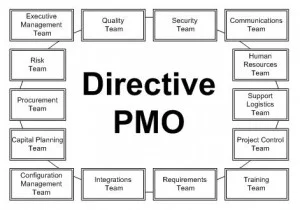
Today I realized I've been supporting and advising a Federal Government PMO for a whole year.  Prior to that, I was the Manager of Software Engineering at an online company that had recently gone public.  I was the sole PMP (Project Management Professional) and  sole Agile Evangelist. Upon my leaving that company, I told my superiors they really needed a PMO if they wanted to offer consistent results, measurable improvements, and increase stakeholder satisfaction.  It was hard at first to shift gears, away from a private profit-driven organization, to Federal governance-driven organization.  At the private company, it was all "being creative" to meet unrealistic goals set by those not versed in best practices.  Since there were no other PMPs, I felt like the lone sheriff in the Wild West.  Now that I'm dealing with the government, I'm surrounded by other PMPs.  There is policy, process, and governance.  Everyone knows their jobs very well.  They know best practices. So you can differentiate the type of PMO I work in compared to others, I've included the 3 basic types below with their definitions.

There are 3 basic types of Project Management Office (PMO) organizations are [1] supportive, [2] controlling, [3] directive.

1. Supportive PMO generally provides support in the form of on-demand expertise, templates, best practices, access the information and expertise on other projects, and the like. This can work in an organization where projects are done successfully in a loosely controlled manner and where additional control is deemed unnecessary. Also, if the objective is to have a sort of 'clearinghouse' of project management info across the enterprise to be used freely by PMs, then the Supportive PMO is the right type.

2. Controlling PMO has the desire to "reign in" the activities - processes, procedures, documentation, and more - a controlling PMO can accomplish that. Not only does the organization provide support, but it also REQUIRES that the support be used. Requirements might include adoption of specific methodologies, templates, forms, conformance to governance, and application of other PMO controlled sets of rules. In addition, project offices might need to pass regular reviews by the Controlling PMO, and this may represent a risk factor on the project. This works if a. there is a clear case that compliance with project management organization offerings will bring improvements in the organization and how it executes on projects, and b. the PMO has sufficient executive support to stand behind the controls the PMO puts in place.

3. Directive PMO goes beyond control and actually "takes over" the projects by providing the project management experience AND resources to manage the project. As organizations undertake projects, professional project managers from the PMO are assigned to the projects. This injects a great deal of professionalism into the projects, and, since each of the project managers originates and reports back to the Directive PMO, it guarantees a high level of consistency of practice across all projects. This is effective in larger organizations that often matrix out support in various areas, and where this setup would fit the culture.

Definition Source:  http://ezinearticles.com/?expert=John_Reiling

The Best Kind Of Contract To Manage Is…(3 of 3)

 Unfortunately, there is no ONE best type of contract to manage. The risk the vendor and customer share is determined by the contract type. The best thing you can do is understand the risks and benefits of each. There are three categories of contracts: Fixed-Price, Cost-Reimbursable, and Time and Material (T&M). In this 3 part series, I defined the contracts in each category. Hopefully, it will help you on the PMP exam and out in the real world.

Time and Materials (T&M) is a hybrid type of contractual arrangement that contains aspects of both cost-reimbursable and fixed-price contacts.  They are often used for staff augmentation, acquisition of experts, and any outside support when a precise statement of work cannot be quickly prescribed.

These types of contracts resemble cost-reimbursable contracts in that they can be left open ended and may be subject to a cost increase for the buyer.  The full value of the agreement and the exact quantity of items to be delivered may not be defined by the buyer at the time of the contract award.  Thus, T&M contracts can increase in contract value as if they were cost-reimbursable contracts.  Many organizations require not-to-exceed values and time limits placed in all T&M contracts to prevent unlimited cost growth.  Conversely, T&M contracts can also resemble fixed unit price arrangements when certain parameters are specified in the contract.  Unit labor or materials rates can be preset by the buyer and seller, including seller profit, when both parties agree on the values for specific resource categories, such as senior software engineers at specified rates per hour, or categories of materials at specified rates per unit.

Image courtesy of Marc Lemmons via Flickr

Risks and Benefits of Cost-Reimbursable Contracts

brokenpig

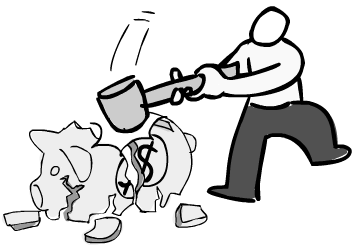
As I mentioned in my previous post, Fixed-Priced Contracts, there is no ONE best type of contract to manage. The risk the vendor and customer share is determined by the contract type. The best thing you can do is understand the risks and benefits of each. There are three categories of contracts: Fixed-Price, Cost-Reimbursable, and Time and Material (T&M). In this second installment of a 3 part series, I will define the contracts in the cost-reimbursable category. It will hopefully help you on the PMP exam and out in the real world.

Cost-reimbursable is a contract category involving payments (cost reimbursements) to the seller for all legitimate actual costs incurred for completed work, pus a fee representing seller profit.  Cost-reimbursable contracts may also include financial incentive clauses whenever the seller exceeds, or falls below, defined objectives such as costs, schedule, or technical performance targets.  Three of the more common types of cost-reimbursable contracts in use are Cost Plus Fixed Fee (CPFF), Cost Plus Incentive Fee (CPIF), and Cost Plus Award Fee (CPAF).

A cost-reimbursable contract gives the project flexibility to redirect a seller whenever the scope of work cannot be precisely known and defined at the start and needs to be altered, or when high risks may exist in the effort.  Frankly put, if the buyer doesn't know what they want, this type of contract allows the project to move forward without the risk to the seller.

  • Cost Plus Fixed Fee (CPFF) reimburses the seller for all allowable costs for performing the contract work, and they then receive a fixed fee payment calculated as a percentage of the initial estimated project costs. The fee is paid only for competed work and does not change regardless of seller performance. The fee amounts do not change unless the project scope changes.

  • Cost Plus Incentive Fee (CPIF) reimburses the seller for all allowable costs for performing the contact work and receives a predetermined incentive fee based upon achieving certain performance objectives as set forth in the contract. In CPIF contracts, if the final costs are less or greater than the original estimate costs, both the buyer and seller share costs from the departures based upon a prenegotiated cost sharing formula, e.g., an 80/20 split over/under target costs based on the actual performance of the seller.

  • Cost Plus Award Fee (CPAF) reimburses the seller for all legitimate costs, but the majority of the fee is earned, based on the satisfaction of certain broad subjective performance criteria. This performance criteria is defined and determined by the buyer and and incorporated into the contact. The determination of the fee is based solely on the subjective determination of seller performance by the buyer, and is generally not subject to appeals.

Image Source: Pictofigo

The Best Kind Of Contract To Manage Is...

  Unfortunately, there is no ONE best type of contract to manage.  The risk the vendor and customer share is determined by the contract type.  The best thing you can do is understand the risks and benefits of each.  There are three categories of contracts: Fixed-Price, Cost-Reimbursable, and Time and Material (T&M).  In this 3 part series, I will define the contracts in each category.  Hopefully, it will help you on the PMP exam and out in the real world.

Fixed-Price is a category of contract involving setting a fixed total price for a defined scope of work to be provided.  Fixed-price may also incorporate financial incentives for achieving or exceeding selected project objectives, such as schedule delivery dates, cost and technical performance, or anything that can be quantified and subsequently measured.   Sellers under fixed-price contracts are legally obligated to complete such contracts, with possible financial damages if they do not.  Under the fixed-price arrangement, buyers must precisely specify the products or services being procured.  Changes in scope can be accommodated, but generally at an increase in contact price.

  • Firm Fixed Price Contracts (FFP) are the most commonly used contract type.  It is favored by most buying organizations because the price for goods is set at the outset and not subject to change unless the scope of work changes.  Any cost increase due to negative performance is the responsibility of the seller, who is obligated to complete the effort.
  • Fixed Price Incentive Fee Contracts (FPIF) are arrangements which give the buyer and seller some flexibility whereby allowing for deviation from performance, with financial incentives tied to achieving agreed to metrics.  Typically such financial incentives are related to cost, schedule, or technical performance of the seller.  Performance targets are established at the outset, and the final contract price is determined after completion of all work, based on the seller's performance. Under FPIF contracts, a price ceiling is set, and all costs above the price ceiling are the responsibility of the seller, who is obligated to complete the work.
  • Fixed Price with Economic Price Adjustment Contracts (FP-EPA) are used whenever the seller's performance period spans a considerable period of years, as is desired with many long-term relationships.  FP-EPA is a fixed-price contract, but with a special provision allowing for predefined final adjustments to the contract price due to changed conditions, such as inflation changes, or cost increases (or decreases) for specific commodities.  The EPA clause must relate to some reliable financial index which is used to precisely adjust the final price.   The FP-EPA contract is intended to protect both buyer and seller from external conditions beyond their control. 

Next in my series on Contracts, I'll define Cost-Reimbursable and Time and Material Contracts (T&M)

Image Source: Pictofigo

Meeting Acceptance Criteria Implies Customer Satisfaction

checklist

checklist

It doesn't matter if your model is Kanban, Agile, Waterfall, or RUP.  You can't close out a project or task without first identifying the Acceptance Criteria.  Acceptance criteria begins to take shape during the first moments of a project or task. If you are utilizing Kanban or Agile, everything pertaining to your deliverable should be captured on your story cards.  This includes story details and acceptance (testing) criteria.  Satisfying all acceptance criteria implies the needs of the customer have been met.

If you following Waterfall, RUP, or similar model, you would expect to identify acceptance criteria, along with scope description and project deliverables, in the project scope statement.  (These are each components of a scope baseline)

It all goes back to requirements and stakeholders' satisfaction.  Remember each requirement should add business value by linking to a business or project objective(s).

Those criteria, including performance requirements and essential conditions, must be met before project deliverables are accepted. Regardless of your model, spare yourself a lot of wasted time AND money by documenting acceptance criteria early.

Mitigated Speech and Project Negotiations

Try this

Try this

Mitigated speech is a linguistic term describing deferential or indirect speech inherent in communication between individuals of perceived High Power Distance. The term was recently popularized by Malcolm Gladwell in his book, Outliers, where he defines mitigated speech as "any attempt to downplay or sugarcoat the meaning of what is being said". He described 6 degrees of mitigation with which we make suggestions to authority:

1. Command – “Implement this

2. Team Obligation Statement – “We need to try this

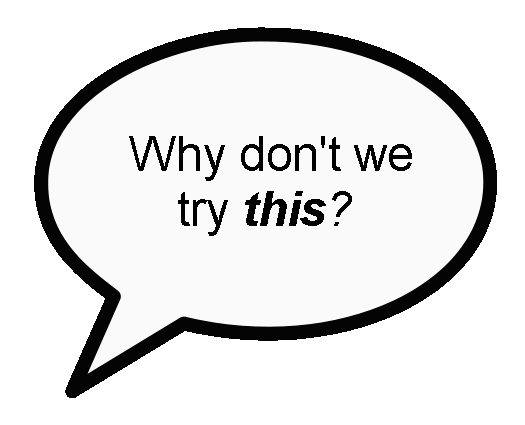
3. Team Suggestion – “Why don’t we try this?”

4. Query – “Do you think this would help us in this situation?”

5. Preference – “Perhaps we should take a look at this an an alternative”

6. Hint – “I wonder if we will run into any issues by following our current process”

As I observe the command and communication structure between a PMO and its members and contractors, I have the opportunity to witness mitigated speech every day.  Being direct (command) doesn't always work.  People need to learn to be flexible in their requests and negotiations if they have the hope those in power will implement new strategies.  Additionally, learn to read those around you to know what degree of mitigation you will use IF you intend to use it.

As I read Outliers, I started to think of the relationship between mitigated speech and Appendix G.8 (negotiation) of the PMBoK.

Negotiation is a strategy of conferring with parties of shared or opposed interests with a view of compromise or reach an agreement.  Negotiation is an integral part of project management and when done well, increases the probability of project success.

The following skills and behaviors are useful in negotiating successfully:

  • Analyze the situation.

  • Differentiate between wants and needs - both yours and theirs.

  • Focus on interests and issues rather that on positions.

  • Ask high and offer low, but be realistic.

  • When you make a concession, act as if you are yielding something of value, don't just give in.

  • Always make sure both parties feel as if they have won. This is a win-win negotiation. Never let the other party leave feeling as if he or she has been taken advantage of.

  • Do a good job of listening and articulating.

To summarize, stride to be a win-win negotiator and be aware of the mitigated speech you are using to conduct your negotiations.

How To Effectively Manage An Offshore Team Of Developers

Offshore TeamsThere are probably two primary reasons you would go with an offshore team. (1) Your customers are also offshore, or (2) you're hoping to save money on development costs.

I'm going to assume your reason is number (2).  Though this post is brief for such a complicated topic, it should give you some things to think about.  Yes, you can certainly save a lot on development expenses. Then again, it can come back to bite you in rework expenses if there are communication issues.

How do you bridge the language barrier? (1) You need a go-to guy or gal who speaks the same language as your developers but will be working at your location. This is a must. Your probability for success is going to go way up by ensuring there is no breakdown in communications.

How do you receive the quality of code you need? (1) Use continuous integration (2) Use test scripts to understand requirements (3) Use short iterations (4) Have regular builds (5) Separate teams by functionality (not activity)

How do you communicate? (1) If you can afford to send/bring someone (an ambassador) over to work with the other team at the beginning of the project, do it. (2) It is critical that your "go-to" has a daily meeting with the team. Select a method that allows each side to see one another. (webcam/Skype) (3) Have everyone use Skype (VoIP) and/or a chat client for one-on-one communications. (4) Keep a Skype connection open between the offices. (5) Use wikis or other collaborative solutions for common project information. (6) Stay away from email, unless it is for formal communication. Information is going to get lost along the way and it will take longer to clarify.

Remember to use parallel communication methods, not serial.