The Impact Of Social Networking On Project Management

A few years back, while studying for the PMP exam, I committed the formula for calculating communications paths to memory.

[N(N-1)]/2

So, what's the big deal? Why is it so important? If you're in the Project Management (or leadership) field, you know all too well how important communications is. I used to call myself a project manager. I now prefer to use the term project leader. What's the difference? According to Warren Bennis and Dan Goldsmith (1997) there are 12 distinctions between managers and leaders.

  • Managers administer; leaders innovate.
  • Managers ask how and when; leaders ask what and why.
  • Managers focus on systems; leaders focus on people.
  • Managers do things right; leaders do the right things.
  • Managers maintain; leaders develop.
  • Managers rely on control; leaders inspire trust.
  • Managers have short-term perspective; leaders have long-term perspective.
  • Managers accept the status-quo; leaders challenge the status-quo.[*]
  • Managers have an eye on the bottom line; leaders have an eye on the horizon.
  • Managers imitate; leaders originate.
  • Managers emulate the classic good soldier; leaders are their own person.
  • Managers copy; leaders show originality.

In order to both innovate and do the right things, I listen and listen a LOT. (Some people listen; some wait to talk) I've watched executives and managers, who knew absolutely nothing about a subject, make uneducated decisions because they were too stubborn or proud to consult a subject matter expert (SME). Good leaders do not operate in a vacuum. They exchange ideas and information with people. Offer free information and it will come back to you tenfold. Listen to knowledgeable people and then make a more educated leadership decision.

Social Media CampaignWhere does social media fit into the grand scheme of things? Old-school managers and executives who believe in the bureaucratic organization and status quo, tend to lean toward command-and-control or top-down management. That group is operating under the assumption people higher in the organizational chart know more. New-school leaders believe in social media. Why? It strips away all of the nonsense and connects people to people. They have real conversations as human beings. They educate and they listen with a freedom to connect at an exponential rate. They are not confined to the notion of an hierarchical organization.

My example is my current engagement, which I have been at for 13 months: Within my direct cross-functional organization chart, I have 28 contacts to interface with. There are no plans to increase the size of this group. [28(28-1)]/2 is 378 communication paths. Not too bad.

TwitterTurn now to option number two, social media like Twitter and Facebook. For arguments sake, I'll say I have 200 followers on Twitter with a growth rate of 10% a month. (I'm actually have 450+ and counting)  Each Twitter Follower is a communications path.

[200(200-1)]/2 = 19,900 communication paths

After one month it would be projected to increase to 21,945 communication paths

Every Friday, people I follow on Twitter recommend others in the industry who I should consider following (#followfriday). Every week, I learn more about my craft and more importantly I get to form relationships with people all over the world. By bypassing the organizational structure to get my information, inbound communications is at a much higher velocity and is now flowing up through the organization.

Social Media helps you be a project leader.


12 distinctions between managers and leaders by Bennis, Warren and Dan Goldsmith. Learning to Lead. Massachusetts: Persus Book, 1997.
Thank you Laurel Papworth for the use of the Social Media Campaign image

* I recommend reading Fighting Status Quo by Pawel Brodzinski
Refine Your Process If You Must Deviate From It

Do you really need documentation

As I mentioned in my post yesterday, Seeing Value From The Customer Perspective, if you think you need to deviate from a documented or understood process, rewrite or refine your process to account for the deviations. Merriam-Webster defines process as a series of actions or operations conducing to an end.  If you are unwilling to modify your process, the deviation is unworthy of being done. I've had a vendor tell me they didn't need to document their processes because they were agile.  (Notice the lack of an uppercase A in Agile).  Leveraging Agile concepts does not mean a lack of documented process.  IF the customer tells me they see the greatest value in delivering documentation, what is this vendor going to respond with?  Sorry, we won't deliver value?  If you use Waterfall, you may be used to generating more paper.  You have to consider documentation on a case by case basis.  Some customers have legitimate needs for documentation and other have wants.  Now go back and read that last sentence again.  Needs...Wants...

A Defined Governance Process

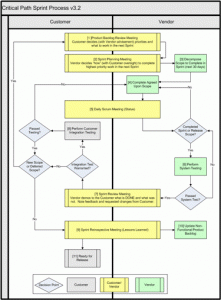
I personally like to go light on documentation.  What I need and what the customer needs are usually two different things.  That being said, I like to understand the rules (governance) before I start anything.  The Microsoft Visio document I included in my last post was a good example of a high level governance (functional flowchart) document. After completing the flowchart, I then detail each activity in a separate document.  What is the input and output?  Is there a formal deliverable associated with the activity? The idea behind the separate document is you won't need the flowchart to describe the process.  For those who have successfully navigated a SOX audit, you know what I'm talking about.  But I digress.  The flowchart activities I documented are not groundbreaking.  The process in this case is an Agile Scrum process with a few defined quality assurance decisions points.  You do not need to go into the Nth degree to understand this process.  Identify some touch points where the vendor and customer interface.  Identity some decision points.  That's it!

I've done these flowcharts for several customers.  I've created them for both Waterfall and Agile development approaches.  If you're looking for a free Microsoft Visio template, which you can edit at will, you can download it here. I zipped it to make downloading easier.  If you're looking for other free templates or worksheets to use on your project or program, you can download them there.

What do you think?  To document or not document.  That is the question. I welcome your comments or feedback.

Regards,

Derek

Seeing Value From The Customer Perspective

I recently sat in a meeting between a vendor and client, where the client was attempting to communicate their need to route new work deliverables to an existing Change Control Board (CCB). The contractor came back and said they believed the CCB in this case would not provide value and perhaps it should be bypassed.

Note to all vendors: Just because a process does not appear valuable to you, it does not mean the process does not provide value. The use of the CCB provides a (formal) control point helping to prevent unauthorized work and cost overruns. This goes further then just having a client billed for unauthorized work. Any work done without prior authorization has a risk of negatively impacting project schedule, cost, or quality. The mere act of doing unauthorized work impacts the scope.

I don't care if you're using Agile, Waterfall, or other methods to deliver value.  What is important is you understand your process and what mechanisms provide the greatest value to the customer.

If you think you need to deviate from a documented or understood process, rewrite your process to account for the deviations. If you are unwilling to change your documented process, the deviation is unworthy of being done.

I created the Visio diagram (above) a few months back to help both the customer and vendor visualize what we were trying to accomplish.  The challenge was implementing Scrum in a very formal and controlled environment.

I certainly recognize many don't have such a formal process.  Instead of CCBs, you may call them Product Backlog Review Meetings.  Counter to this, you may have a very fluid and simple software development life cycle (SDLC).  If so, you still need to understand your process and you still need to communicate with your customer.  Understand what their highest priorities are and deliver.

How To Solve A Personal Branding Paradox

I’m Derek, a project manager and technology geek who lives and breaths general project management, Agile, Scrum, Kanban, and technology.  You can follow me on Twitter @derekhuether or if you really liked this article, subscribe to the RSS Feed. Over the course of the last 15 years, I've really expanded my personal brand.  I started out as a full on Tech Geek.  I launched my first startup in October of 1996.  Yes, when the Pentium 133 was the latest thing.  It was a good ride.  Sure, the company died off after 10 years of business but I got my exit and I learned a lot.  Two things I learned.  One, I like to interact with people.  Two, I don't like to interact with people when they don't want to interact with me.  Let's not waste our time here, people.  Who would you rather have a conversation with?  [1] That guy or gal who walks around the room pushing his business card into everyone's face.  Or [2], that guy or gal who you know has similar interests or passions as you.

After leaving the hardware-and-software-geek world for the application development world, I found a niche with project management.  I loved the idea I could help solve a problem (deliver on time, on budget, within scope) when given the opportunity to do so.  I could identify a need and provide a solution.  The need to talk project management when dealing with Businesses, Government Agencies and Educational Institutions led me to get my PMP® Certification.  The need to empower my development teams led me to get my Certified Scrum Master Certification.  The need to optimize my work throughput led me to champion the use of a Personal Kanban.

All of these are all mere tools in my toolbox.  But, when you put them all together, they start to describe my personal brand.  I'm a guy who believes in transparency, technology, and information dissemination.  I deliver products with passion, commitment, and skill.

So, what's the paradox?  I've been writing The Critical Path for a while now.  Since it's launch, I've grown more and more passionate about things other then just project management.  I really have two options.  [1] Launch another blog with my personal perspective and focus The Critical Path on my professional perspective. [2] Expand The Critical Path to include more about my other passions.

I love going on Twitter and finding a thousand personal brand experts or social media experts. (That's kind of a joke)  But, what I believe in most is the wisdom of the crowd.  I would love to see what you have to say.  If you have any questions or comments, please feel free to post them below.

Pillar Technology is Hiring

Pillar Technology is ramping up several large projects in Columbus, OH and Detroit, MI. They are in need of a bunch of people and have opportunities at many different experience levels. They are looking to hire immediately and will entertain people who want to work 1099, W2 hourly, or become full time employees. Pillar's strength is the quality of their people and are pretty selective about who they bring in. They are looking for people that are technically excellent, have great communication skills, and will fit in well to the Pillar culture. Go to Mike Cottmeyer's blog for more details.

To be considered for their technical positions, you need to be an experienced Java developer or technical tester and you MUST have experience with TDD.   Other skills they are looking for are:

  • Jboss Portal
  • Portlet Specification
  • XML Jibx parser
  • Rest
  • Strong UI / JSP experience
  • Maven
  • Team City
  • EasyMock

The more of these you have the better.

Need more information?  Of course you do! Go to Mike Cottmeyer's blog for more details.

Attention Haters - Big Numbers For PMPs In 2009

Data from 2009 issues of PMI TodayThis morning I picked up my January 2010 issue of PMI Today hoping to find something inspirational to write about. Upon realizing PMI Global Congress 2010 - North America is going to be in Washington DC, this October, I decided to write a blog post about it.  Just when I thought I had something local to write about, I noticed some statistics on PMI® Certified Project Management Professionals (PMPs) on the same page.  Though the statistics are only through November, they were very compelling. You may ask, how did I create the chart depicted above?  I went back to each copy of PMI Today and located the monthly data on PMP credential holders.  I know there are haters out there who go on and on about how having the PMP doesn't make you a better project manager.  No, but it does say you speak and understand the same "PMI" language.  According to the data, 356,419 people are currently certified in "speaking" the language.  That is one hell of a number!  We may have all drank the cool-aid but let's face it, the credential IS recognized when people are looking to hire a project manager. So, here are some interesting specifics.  In January 2009, there were 322,250 Active PMPs. In November, the most recent data available, there were 356,419.  Do the math and you find an overall increase of 34,169 in 11 months.  As I looked at the month-to-month numbers, I did find some attrition.  That attrition really surprised me in October.  Even with 3,102 new PMPs, there was still an overall loss of 14,092.  With an individual membership renewals priced at $129, I imagine that opened a few eyes.  Did these people no longer find value in the credential?  Did they retire? Did they die?

Another interesting data point was for the months of June and July.  June saw the certification of 13,920 new PMPs, up from 8,419 the month before.  That number plummeted to a mere 689 in July.  Again, what happened?  Did everyone go on vacation?

One of my jobs is to see trends in data.  I've been doing it for years.  When you look at two dimensional data over time, it does some really interesting stuff.

If you have any questions or comments, please feel free to post them below.

Review of the iStudy PMP App for iPhone and iPod Touch

Disclaimer: Though I recommend this product, I am not financially benefiting from this review.

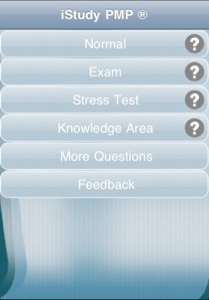
main page

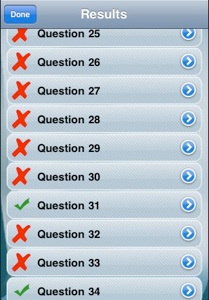
Questions and Answers

The iStudy PMP is an iPhone and iPod Touch application specifically designed to help those aspiring to pass the PMP® Exam.

If you have seen sample questions from the PMP exam, you know the pain points; double-negatives, lengthy questions, what is the "best" answer...  When I prepared for the PMP Exam a few years ago, I spent several hundred dollars for a program that simulated the PMP exam.  I'll admit, it worked great!  But, what if I could have passed the exam and also saved several hundred dollars?  If this application was around when I was preparing to sit for the exam, I would have purchased it first.

Interface

iStudy PMP contains 200 questions that intend to replicate the PMP exam. The interface is clean and it allows the user to concentrate on answering the questions.  If you come to a question you're not sure about, you can Mark (skip) it.  I thought I ran into some problems with the Mark feature.  Swiping my finger across the screen didn't always advance me to the next card.  After some practice, I realized it was just me. The application was working just fine.

Not to get ahead of myself, but there is a results page to see correct/incorrect results.  One thing missing is a similar navigation page showing the skipped questions.  You're given the opportunity to go though the skipped questions at the end of the exam but you can't see how many skipped you have.  You just have to go through them one by one.  I contacted the creator of the application and he confirmed this is something to be resolved in a future update.

Tests

iStudy PMP has 4 different modes designed to cater to different learning styles.

Normal - This mode displays all 200 (randomized) questions and allows you to sequentially browse. You can go back and forth as many times as you wish, but you have to go in sequential order.

Exam - This mode is similar to the Normal mode minus the fact you have a time limit of 4 hours to answer all of the questions. You can go back and forth between questions as many times as you need to change answers.  If after 4 hours you have not answered all of the questions, the exam will automatically end and your results calculated.  This is good because if there was one thing I took away from doing full length practice exams, they help you build up your stamina.

Stress Test - This is a pretty interesting mode. I like that you choose the number of questions you want to answer (out of 200) and an amount of time you wish to allow yourself.  If you fail to answer a question before the timer hits zero then that question is marked as incorrect and the application advances you to the next question.  Let's say you set the stress test to 15 questions and 2 minutes per question.  Your stress test will be done in 30 minutes.  Pretty cool.

Knowledge Area - The PMP Exam assesses your competency from 9 Knowledge Areas. This mode is like the normal mode but it allows you choose a specific knowledge area.  This is a nice feature when you know you have specific knowledge weaknesses.

Results Screen

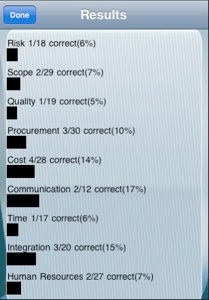
Once you have completed a test, or if you intentionally end it, you will be presented with the Results screen. Here you will see whether or not you passed the practice exam. Results will be broken down by knowledge area so you can see where you need to improve.  All questions will be listed as either correct and incorrect with an option to display the entire question and answers.

Summary

For $10, I say go for it!  One feature I really like is the questions appear completely random.  So, each test should be unique.  If you're interested in this app, you can get it from the iTunes store, go to www.istudyapps.com or click here.

Provide Value To Your Customer And Thank Them

Gary Vaynerchuk Thank YouBack in November (2009) I was watching Episode #24 of This Week in Startups featuring Jason Calacanis.  His guest that week was Gary Vaynerchuk, of Wine Library TV fame and countless appearances on TV.  Sometimes I arrive a little late to the game.  I Don't watch a lot of television so I hadn't seen Gary before.  While on the show, he promoted his new book Crush It! and I was absolutely intrigued by his level of passion and drive.  My motto is anything is possible through passion, commitment, and skill.  It doesn't matter if you're a project manager, developer, or entrepreneur.  You can and SHOULD have all three, regardless of your trade.

I've been itching to get this book.  Because I have a lengthy commute, I waited until it was available in audio version.  I downloaded it last night and started listening to it this morning.  After my commute today, I arrived to the office not wanting to turn it off.  The book is inspiring, motivating, and I identify with several things Gary has experienced and promotes.  I am a firm believer if something is bad, you can say something about it.  But, if something is good, you need to stand on the tallest hill and yell at the top of your lungs.

The hill, in this case, is Twitter.  I wrote just a single tweet:

Started listening to Crushit! by @garyvee on my drive in today. Get the audio version (extras), even if you have the actual book.

Within a few minutes, Gary tweeted back

thank u !

Now that, people, is commitment to customer service!  With almost 850,000 people following him on Twitter, he took the time to thank me.  Though it was something so simple, it's a level of customer service everyone should and WILL come to expect in the coming years.

When I deal with my customer(s), I get excited, optimistic, and passionate.  I work HARD.  Why?  I love it!  Sure, I get paid for providing value but I make sure I thank them from time to time.  There must be a commitment to customer service.  The interesting thing is, it can be contagious.

So, work hard and be passionate about what you do.  Be committed to deliver value to your customers.  And don't forget to be skilled at how your implement your solutions.

Disclaimer:  I will not financially benefit from the positive review of Gary's book (but I hope he does).