The Critical Path Week Ending February 13

January 28 through February 5This week we dealt with the great blizzard of 2010.  It provided me extra time to write.  Then again, it took that extra time I thought I was going to spend on vacation.  My wife thinks I live in a world where everything is related to project management.   I go on a little rant about treating your customers right and then also lend an ear to my colleagues.  Read how I handle being both the sponsor and the project manager on a project.

2/7/2010

Snow Removal From an Agile PM Perspective

With our home getting hit with over 30 inches of snow in one weekend, I compared our HOA and the snow removal team to an Agile team.  Read how they went from failure to success, in one customer's eyes...

2/8/2010

My Big Fat Greek Project

My wife compares me to the father on My Big Fat Greek Wedding.  I'm no Gus Portokalos, but give me a word, any word, and I will show you that the root of that word is Greek.  Actually, show me a scenario, any scenario, and I will show you how it can be related back to Project Management.  If that doesn't do it for you, just put some Windex on it...

2/9/2010

The FedGov Fail Day 3

Jhaymee (@TheGreenPM) Wilson inspired this post.  I was frustrated the Federal Government would be closed for 3 days in a row.  I believed we could all be working, at least in a limited capacity, from home.  If the Federal Government could have a plan in place for H1N1, why the hell couldn't plan for snow?...

2/10/2010

MS Project Task Types – Fixed Work – Units – Duration

Upon reviewing a vendor’s Integrated Master Schedule, created in MS Project, I noticed something very peculiar. Where some tasks could clearly be marked as Fixed Duration, everything was Fixed Units.  In the post, I include a YouTube video to help you understand the difference between Fixed Work, Fixed Units, and Fixed Duration...

THE most important thing is the customer

...You’re welcome?  Did I say thank you? No, I didn’t.  I offered a pleasantry. Just have a nice day.  Goodbye, our business relationship has completed.  Have a nice life...Listen to them.  Be polite.  Deliver value.

2/11/2010

How Do You Know Your Metrics Are Worth It

So you want to create some metrics.  More importantly, someone has told you that you need to create some metrics.  How do you know if you’re just making work for yourself or if you’re just putting a spin on the same old data?...

2/12/2010

Sometimes It Is Best To Just Listen

It was the first day our team had been together in a week.  The DC FedGov closures have really rattled people.  As contractors and consultants, we are not Government employees.  We play by different rules.  Depending on your contract, if the FedGov is closed, you may not get paid...

2/13/2010

The Difficult Task of Managing My Logo Selection Project

Using 99Designs has allowed me to crowd source a design.  I listed the price I was willing to pay, the duration of the contest and provided as much background information as possible to enable designers to provide me with quality submissions.  We immediately entered a rapid prototyping stage...

Sometimes It Is Best To Just Listen

The Doctor Is InToday was a very interesting day.  It was the first day our team had been together in a week.  The DC FedGov closures have really rattled people.  As contractors and consultants, we are not Government employees.  We play by different rules.  Depending on your contract, if the FedGov is closed, you may not get paid. For those working under a corporate umbrella, where paid time off is offered as a benefit, this has left a lot of people very unhappy.  Without an opportunity to work from home, some were asked to take paid time off or leave without pay.  Either way, it hurts.

I can see both sides of the coin and empathize with both.  From a contract holder perspective, if they compensated each of their employees the 4 days the Federal offices were closed, it could do irreparable harm to the bottom line.

From the contractor and consultant side, there are feelings of desperation and abandonment.  I heard story after story about vacations being canceled or accepting a day without pay because they felt there was no other choice.  32 hours of the rainy day fund just left their accounts and there isn't a damned thing anyone can do about it.  The lack of control has put many on tilt.

Listening to people speak their minds, some had real rancorous opinions of the situation.  I'd like to think there is a happy ending in all this and it will all work out in the end.  Unfortunately, there is snow in the forecast next week.

Image courtesy of ournameisblog.blogspot.com

How Do You Know Your Metrics Are Worth It

GQM Paradigm

GQM Paradigm

So you want to create some metrics.  More importantly, someone has told you that you need to create some metrics.  How do you know if you're just making work for yourself or if you're just putting a spin on the same old data?

Ask yourself what the goals of your project are.

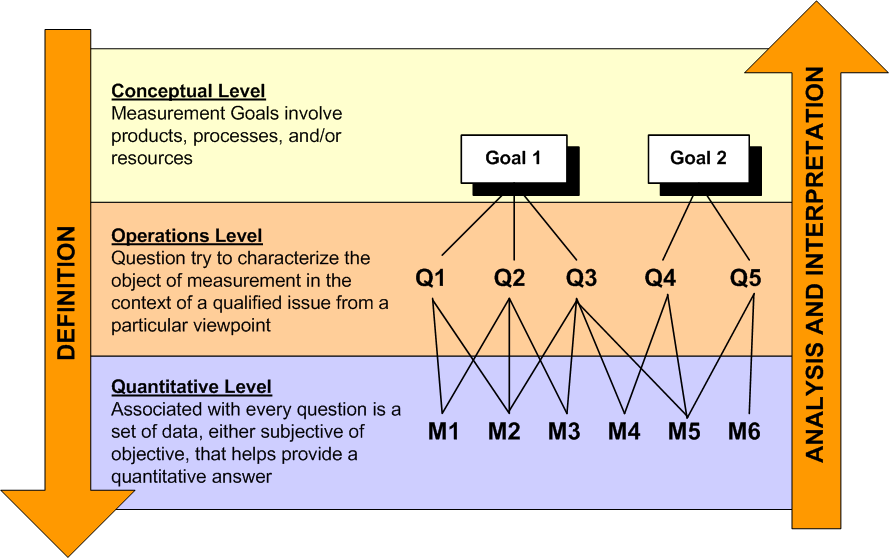
In trying to determine what to measure in order to achieve those goals, I recommend using a Goal-Question-Metric (GQM) paradigm. It can actually be applied to all life-cycle products, processes, and resources. I've been using this process for a few years and it really helps me creat a quality metric.  The GQM paradigm is based on the theory that all measurement should be [1]goal-oriented i.e., there has to be some rationale and need for collecting measurements, rather than collecting for the sake of collecting. Each metric collected is stated in terms of the major goals of the project or program. [2]Questions are then derived from the goals and help to refine, articulate, and determine if the goals can be achieved. [3]The metrics or measurements that are collected are then used to answer the questions in a quantifiable manner.

Here is an example of the GQM in action:

Goal (use this 4-step process to shape a goal)

[1] Purpose [2] Issue [3] Object (process) [4] Viewpoint

Goal 1

[1] Purpose [2] Issue [3] Object (process) [4] Viewpoint

Maintain a maximum level of customer satisfaction from the Help Desk user’s viewpoint

Question 1

What is the current help desk ticket trend?

Metrics 1 Metrics 2 Metrics 3 Metrics 4

Number of help desk tickets closed Number of new help desk tickets % tickets outside of the upper limit

Subjective rating of customer satisfaction

Metrics 5

Number of new help desk tickets open

Question 2

Is the help desk satisfaction improving or diminishing?

Metrics 6 Metrics 7 Metrics 8 Metrics 9

Number of help desk calls abandoned Number of help desk calls answered Number of help desk calls sent to voicemail

Subjective rating of customer satisfaction

As the great Lord Kelvin once said, "If you can not measure it, you can not improve it."

Image based on Basili, Caldiera, and Rombach "The Goal Question Metric Approach", 1990

THE most important thing is the customer

Remember the last time you were at the grocery store and the clerk responded by saying something unrelated to what you asked? This cashier is focused on ringing up your items.  They don't engage you at all.  No hello; no how are you; no did you find everything.  He or she finishes ringing up all of your items and you forward a have a nice day and they respond with something canned like you're welcome. You're welcome?  Did I say thank you? No, I didn't.  I offered a pleasantry. Just have a nice day.  Goodbye, our business relationship has completed.  Have a nice life. This is just simple and common courtesy.  It is being polite.  Your parents should have taught you these things as a child.  If you want something, say please. If someone holds the door for you, you damn well better say thank you...and if someone thanks you, say you're welcome.

So, why do so many people forget this in business?  I understand some customers can be difficult.  I understand user expectations can sometimes be unrealistic.  But let me say this.  Take a minute to listen to what your customer is saying.  You should be polite and courteous to them as often as you wash your hands after going to the bathroom.  If you don't do that 100% of the time, you have more problems then being polite.  But I digress.

Your customer is THE most important thing in your job.  It's not the process you follow.  It's not the product or service you offer.  It's the customer. Wait, did I say that?  Let me say it again. THE most important thing is the customer.  Listen to them.  Be polite.  Deliver value.

(image from sft.edu)

MS Project Task Types - Fixed Work - Units - Duration

Upon reviewing a vendor's Integrated Master Schedule, created in MS Project, I noticed something very peculiar. Where some tasks could clearly be marked as Fixed Duration, everything was Fixed Units.  I think there are two answers for this.  Either there was a misunderstanding about the work to be performed or the person doing the schedule needs some help understanding task types.  I believe working with MS Project can make your eyes bleed if you're not used to it.  But if you're armed with just a little information about task types, it can be a whole lot easier. I would love to go into a detailed explanation about Fixed Work, Fixed Units, and Fixed Duration.  If I did, however, you'd probably leave my site never to return.   Instead, I found a very helpful video on YouTube.  Why go hunting for this stuff when you can just find it here?

The FedGov Fail Day 3

As we enter the 3rd day of Washington DC being shut down, I ask myself why.  It's 2010, for crying out loud!  You'd think they would find a way to keep things operational.  Just because government employees can't report to physical locations, doesn't mean they can't work, right?  From the OPM.gov website, Federal agencies in the Washington, DC, area are CLOSED. This means...

  • Federal agencies in the Washington, DC, area are closed. Nonemergency employees (including employees on pre-approved leave) will be granted excused absence for the number of hours they were scheduled to work. This does not apply to employees on leave without pay, leave without pay for military duty, workers' compensation, suspension, or in another nonpay status.
  • Telework employees may be expected to work from their telework sites, as specified in their telework agreements.
  • Emergency employees are expected to report for work on time.
  • Employees on alternative work schedules are not entitled to another AWS day off in lieu of the workday on which the agency is closed.

Now, this post isn't necessarily about government employees, a majority of whom will just stay at home and get paid.  Don't get me wrong, I care a lot about my government counterparts.  Some of them work darn hard and are up late at night keeping things running.  This is about all of us who support the government.  In a day and age when the government needs to be nimble and innovative, I sit here knowing I'm not necessarily going to get to bill an hour of my time, while the Federal agencies in the Washington DC area sit idle.  No, I certainly can't do 100% of what I was hired to do but I have things I could have caught up on.  I have a constant rotation of priority deliverables that arrive in my inbox, ready for my review and recommendations.  I don't need to be on site to read a document about cost and schedule variance on CLIN 123, in order to deliver value.  But guess what, that's exactly the case.  If I'm not physically on site, I have to get special approval to do any work and bill any time.

As Jhaymee (@TheGreenPM) Wilson tweeted today, the recent Snowmageddon in DC brings visibility to the Federal Government's lack of a risk management policy, which includes teleworking.  I believe the policy should include contractors.  My FedGov PMO identified a strategy to keep us operational, in the event H1N1 hit the agency.  The strategy was a mandate from higher in the government.  So why then wouldn't there be a plan to keep us operational in the event of inclement weather?  This just proves, in cases like this, the Federal Government doesn't plan to fail; It just fails to plan.

My Big Fat Greek Project

Today my wife looked at me and said, "ya know, you're like that guy on My Big Fat Greek Wedding. We talk about something, anything, and you tell me how it relates to Project Management."  You know what?  She's right!  We talk about snow removal...Agile. We talk about getting through the honey-do list...Kanban.  I asked her what I should write this post about.  She said, My Big Fat Greek Wedding. The person she was referring to was Gus Portokalos. He  said, "Give me a word, any word, and I show you that the root of that word is Greek." Oh Gus, you wise man.  Recently, I decided I was going to write a lot more.  That leaves me with a bit of a challenge.  I don't want to produce garbage just for the sake of publishing something.  I see people like James Rich, a blogger I follow, push a volume of product but his quality hasn't gone down.  As a result, I find myself not only internalizing project management but also verbalizing it at every turn.

Yes, I absolutely believe if you give me a topic, any topic, and I will show you how that topic relates to project management.  So, if by chance you read my blog one day this next week and I'm ranting about how a particular restaurant could offer better service if they employed Agile Methods instead of following a Waterfall Process, you'll be forewarned.

Remember, there are two kinds of people - Project Managers, and everyone else who wish they were Project Managers.