How To Prevent Your Project From Hemorrhaging

Triage Your ChangesThis post is in response to a post written by Jennifer Bedell on the PMStudent blog about goldplating. Goldplating is very common in application development and can be very expensive. If you're dealing with Waterfall, it's a little more obvious when it's happening.  Some may argue, but I've seen it happen in Agile as well.  I've sat across the table from a vendor and asked, are you prepared to roll back every one of these changes?  Their eyes get big because why wouldn't the client want these changes?  Well, too many times a developer is in the code and they think, while here, why not make this additional change we planned to do next month.  Or, now that I'm here, it makes a lot more sense if I do it like this versus what we originally thought.

In short, Jennifer wrote about goldplating caused by testers. She asked

why is it always the developers who get blamed for goldplating? When you consider the cost of change increases as the project timeline progresses, it becomes evident that, in addition to increasing scope, goldplating by a developer can also be costly. Goldplating by a tester can occur when a tester goes beyond the stated requirements in an effort to produce a “quality” product. A tester may feel that their suggestion would improve the customer experience so they log this in the defect log.  While their suggestion may do exactly what they envisioned, if it was not within the scope of the stated requirements, it becomes a form of goldplating or “feature creep”.   A tester’s job is to ensure that a quality product is delivered, but many testers rely on their own definition of quality rather than using the requirements to define quality...

I’ve seen team members at every stage of the Software Development Life Cycle (SDLC) attempt to goldplate, with the best of intentions. Regardless of where you are in your development process, any time there is a requested change to the baseline, there should be a control mechanism.  I call that mechanism a triage. Be it the customer or a customer representative (Project Manager, Product Owner, or BA), someone needs to vet anything and everything which could impact the baseline.  These changes need to be prioritized and reviewed.  I'm not saying changes should not be made.  I'm saying they need to be properly vetted.  Changes impact the schedule, the budget, and in the end...customer satisfaction.

Without this control point, I think you’re guaranteed to see creep somewhere in your project and you will see it begin to bleed time, money, or both.

Yes, we certainly want to deliver the greatest value to the customer. But, creep increases risk and that’s not value.

Am I just a control freak or do you agree with me?
How Owners Managers and Leaders Differ

I was asked a very interesting question today, requiring me to stop and think. How do I believe being an entrepreneur and a business owner differ? It's a very good question because if you don't know either an entrepreneur or business owner, I don't know how any textbook answer would satisfy. From my perspective, a business owner's identity is merely the act of having and controlling property.  They could potentially inherit the family business, therefore becoming a business owner.  They could be very excited or could care less, looking for an exit strategy.

Entrepreneurs, on the other hand are passionate, committed, skilled, creators of value.  They create because they have a fire in their belly.  As an entrepreneur, they can't help themselves.  It's in their DNA.  They are so laser focused on what they are trying to create, people can either think they are crazy or brilliant.  But, with that charisma, people will be inspired and follow.

These contrasts aren't too far off from Project Managers and Project Leaders. PMI defines a Project Manager (PMBoK Page 444) as the person assigned by the performing organization to achieve the project objectives. As I wrote in a previous post, there are several contrasts between a manager and a leader (Bennis & Goldsmith 1997)

  • Managers administer; leaders innovate.
  • Managers ask how and when; leaders ask what and why.
  • Managers focus on systems; leaders focus on people.
  • Managers do things right; leaders do the right things.
  • Managers maintain; leaders develop.
  • Managers rely on control; leaders inspire trust.
  • Managers have short-term perspective; leaders have long-term perspective.
  • Managers accept the status-quo; leaders challenge the status-quo.
  • Managers have an eye on the bottom line; leaders have an eye on the horizon.
  • Managers imitate; leaders originate.
  • Managers emulate the classic good soldier; leaders are their own person.
  • Managers copy; leaders show originality.

So, what are you?  Are you happy? Why?

(image by apogeehps.com)

What You Need Is Some Kaizen

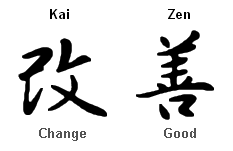
Kaizen - Change Good

While sitting in a governance meeting the other day, I heard how (before I joined the team) a vendor brought in some high paid six sigma black belts to try to bring the vendor governance workflow in line with my client's governance workflow.  My client wasn't sure what they got out of the deal, but if you have a black belt in something, it should be good...right?  Because this venture proved fruitless, the vendor announced, "what you need is kaizen!"  That may be what they said, but it's not what my client heard. This was paraphrased by one of my client's team.  In trying to understand what she was saying, we had a quick back and forth that went a little something like this:

The vendor said there was something that would fix everything. Cry Pan or Pie Pan or something like that.I looked at her and asked, do you mean "kaizen"?Her eyes got really big and she then started to matter-of-factly point at me. That's it! That's it! Now, what does it mean?I said it just means improvement or refinement.She looked disappointed. That's it?Yep, that's it.

Now, I know it's not that simple.  There are no silver bullets.  I do believe in using refactoring or refinement to get you where you need to be, but that's going to be another post.  This post is more of a shame on you post.  Anyone out there who uses a new term, particularly one in a foreign language without explaining it first, shame on you!  Anyone out there who proposes there are silver bullets in project management, shame on you! And, anyone out there who proposes there are silver bullets in project management, uses a new term to label it, AND charges a lot of money for it, shame on you!

I strongly believe approaches like Agile, Kanban, and others bring a lot of potential value to programs.  Customers don't need snake-oil nor do they need silver bullets.  What we have here is, a failure to communicate.

I was thinking, maybe I should start a practice and say it will solve all your problems.  I can call it Verbesserung.

Any takers?

How to Thank a Managed Camel

How to Manage a CamelMy post today is an easy one.  I was informed I am the winner of the very first Freedom of Speech February (FOSF) giveaway from How to Manage a Camel.  My comments last week on a blog post by Gary Holmes earned me a free copy of the Method123 Project Management Methodology (MPMM™) Professional from their partners at Method123. All I did was pass praise in my comments on a Holmes post regarding common courtesy and the little things candidates should do beyond merely sending in a CV.

Reading his post inspired me to write a post of my own, THE most important thing is the customer.  I sometimes get a little worked up over the need (not the want) for common courtesy or being polite.  What else is free to you but can carry so much value to others?

So, thank you to the team over at Arras People and How to Manage a Camel.  You provide wonderful insights on your blog and I enjoy reading it while having my first cup of coffee every morning.

My advise to people out there is to get involved in the conversation.  Your thoughts and opinions are important and they should be heard (or read). I didn't post a comment because I thought I could win a contest.  I did it because I thought Gary wrote a great piece and he should be recognized for it.

If there is one thing you do today, recognize someone for the work they do.  You never know how you may be rewarded for that selfless act.

Creeping Ever So Closer To Closure

As my startup project is creeping ever so closer to its closure and the actual launch of the product happens, I'm feverishly completing activities late into the night.  It's not easy working crazy hours to get this done.  My family goes to bed, I drink a pot of coffee, and get to work.  An entrepreneur (Jason Calacanis) once said starting is easy; finishing is hard.

He wasn't kidding!  As a project manager, managing my own project for a product related to project management, you can see there is a little irony.  But, I really think this is going to help a lot of people and it will be worth all of the sleepless nights.

Today's activities included

  1. Initial rebrand of the HueCubed twitter page
  2. Initial load of the new HueCubed logo to the website
  3. Set up the blog component
  4. Post 1 free question and answer (with the plan to do it daily)
  5. Load 10 questions and answers into the database

Mission accomplished.  I completed the 5 activities and am ready to call it a day (night).  Though we're not quite ready to launch, please feel free to follow me or subscribe via the RSS feed.

Thank you all; and to all a good night.

Interesting PMI Perspective On Claiming PDUs

PMI PDU ClaimAfter one of my readers asked me about PMP PDU claims, I made a telephone call to PMI. The question revolved around Category 2H and the proper way to prove you have met the criteria of the PDU.  In the past, I purposely formatted round-table discussion agendas a certain way to make it easy on the PMPs to claim PDUs.  So, what proof do we need to claim category 2H PDUs?  And, how many PDUs can you claim for being employed as a project manager? Category: 2H Description: Practitioner of project and/or program management services for more than 1,500 project hours per calendar year. Maximum PDUs: Time in service 6 months: 5 PDUs Maximum 15 PDUs may be earned per cycle (3 years).

What does that mean?  Based on the telephone conversation I had, if you've worked as a PM for at least 6 months, you can claim 5 PDUs.  Otherwise, if you are able to say you spend more than 1,500 hours per calendar year in that roll, you also qualify to claim the 5 PDUs.  Within your Continuing Certification Requirements (CCR) cycle, which is now 3 years, you can do this 3 times.  Do the math and you have a total of 15 maximum PDUs, if you're a full time PM.  That's not bad!  You're 1/4 the way to meeting the goal of 60 required PDUs per CCR and you haven't spent a dollar on training.

What about proof?  When claiming PDUs for something like a round-table discussion, the only proof you need is an agenda or something similar. But, I was really surprised by they answer I got from PMI for Category 2H.  You don't need any proof.  When I was audited, prior to taking my exam, I provided a detailed account of my project experiences and areas of focus.  None of this is necessary to maintain your credential. I was very specific how I framed my question to PMI.

Me: Please confirm, yes or no, if I have my PMP certification and I show up to work every day with the title of PM, I rate 5 PDUs a year?  Nothing else is required?

PMI Answer: Yes, that is correct

I have to admit, I don’t agree with this.  What's the point of telling people to follow a process if you have no mechanism in place to verify they are following it correctly?

What do you think?

Getting Exactly What You Want

I just wrapped up a week long logo design project at 99Designs, with an intellectual property transfer agreement.  Flash back to August 2009, when I was watching Episode 13 of This Week in Startups. In it, there was an interview with the founder of a disruptive startup which connects passionate designers from around the globe with savvy clients who need design projects completed in a timely fashion without the usual risk or cost associated with professional design.  The company is called 99Designs.  With less than 30 days from our startup launch, it was time to complete a scheduled task titled Get logo for HueCubed. Because this is a bootstrapped effort, my budget was very low.  With a mere $150 to award to a designer, I was told it could go a long way on 99Designs.  As the contest sponsor, I answered a few questions about what the logo was for and any preferences that could help designers create original artwork to meet my needs.  The website was very straightforward. What was very helpful was it allowed both a public comment board and private comment board for your contest.  With 106 logo submissions, we narrowed it down to 3 designers.  Mictoon, Richard Scott Design, and mèrshî

With permission from two of the designers, I wanted to post submissions that made it to the finals.

Mictoon was the first to submit to the contest and continued to provide revised logos up until the end.  This designer was impressive in responding to every request we had.  I would post a comment about what I liked and what I did not like and we would get new submissions within a few hours.  I greatly appreciated the efforts made.  But with all contests, there can be only one winner.  Still, if you're ever on 99Designs, I would recommend you send a direct message and invite a submission.

Another very impressive designer was Richard Scott Design.  Within just a few iterations, this logo was as professional as it could be.  Again, the designer was very responsive to our requests.  That's the one thing I think made this effort such a success.  There was a huge volume of communications from both the designers and us.  I've never seen a successful project, when people operated in a void.  The more communications, the greater probability for success.

And this brings us to the winning submission.  mèrshî made the submission below and we were kind of taken back.  It had balance, clean lines, and nice colors.  The graphic could stand alone or could be paired with the font.  We made sure the font was under GPU/GPL so we wouldn't have to pay anything extra or hit a legal snag.  Within a few hours of winning the contest, multiple high res versions of the logo were provided to us, and we signed the intellectual property transfer agreement.  Again, 99Designs made it very easy to take ownership.  We really want to thank mèrshî for being so very accommodating, ensuring we had everything we needed.

I would greatly recommend 99Designs to anyone who needs a graphic.  As a disclaimer, I am not being compensated by 99Designs in any way for the review I am writing.  To the contrary, I paid them!

When you’re bootstrapping a startup, you do what you can with the resources you have.  Thank you to Jason Calacanis for creating and hosting This Week in Startups.  Without the show, I might not have heard of 99Designs.