My Personal Kanban 2.0

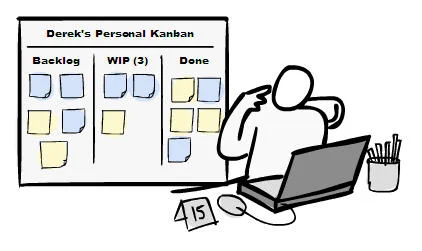
I commonly get asked what I personally use to manage my work. The answer is almost too simple. I use a Personal Kanban. Now, I'm no efficiency guru. I'm no expert on Kanban. I just need a simple system that satisfies a few requirements and makes sense to me.
Personal Kanban

Personal Kanban

Requirements

  1. I need something visual to combat my ADD.

  2. It must visually capture all of my Backlog of work.

  3. I will help me visualize what Work is In Progress.

  4. It allows me (and others) to see what got Done this week.

Now, I've been using task boards for probably half a decade now. When you have that one stakeholder who cruises by your office or cube (constantly) and asks what you're working on, you can point at the wall and not even look up from your monitor. The board proves its worth just by cutting down on those people interrupting your day.  After a while, people get used to knowing what's going on and appreciate the transparency.  It's strange that I need to point that out.  Who benefits by not embracing transparency?  That may be a question left to the comments.

The key difference between a Kanban board and a regular task board is a column limiting your work in progress.  My first exposure to this was from a Scrum Master training session being led by Sanjiv Augustine. Sanjiv displayed a PowerPoint slide of what appeared to be a Los Angeles freeway.  During rush-hour, the number of vehicles coming onto the freeway is limited (by on-ramp lights).  This attempt to control the volume of traffic flow onto the freeway allows vehicles already on the freeway to move at a faster pace and in turn exit the freeway.  This visual freeway analogy was like a light bulb moment for me.  When I got back to the office and began limiting my Work In Progress (WIP), I did indeed increase my delivery rate.  The days of multitasking are now in my past!

Jim Benson

Soon after I started using a Kanban, I met Jim Benson of Modus Cooperandi.  I would describe Jim as a Kanban Sensei.  If you ever want to know more about Kanbans, Jim's your man.  Go check out the  Personal Kanban website.  Though Kanban is kind of a background business process to me, I still check out the site from time to time to see how others are using Kanban.

Tool

To wrap this up, there's only one "tech" tool I use to bridge the gap between my home and office.  It's call AgileZen.  AgileZen is a Kanban web application.  Though I have all of my work  work on my Kanban board at the office, my wife would frown on seeing a wall of post-it notes next to my desk at home.  So, I use AgileZen to manage both my personal and work tasks while away from the office.  Some people may choose to just use the electronic version.  I just can't let go of the satisfaction of moving a post-it note from WIP to Done.

Graphic: Pictofigo

Why Agile Might Not Work (Video)

Why Agile Might Not Work

I was minding my own business when I noticed a tweet by Alistair Cockburn.  He clearly thought something was funny so I figured I'd check it out.  What awaited me was this video.  If you understand Agile or just interested about it, you should spend the next 3 minutes and 14 seconds enjoying a creative perspective on why Agile might not work for you.  It's very tongue-and-cheek.  The slideshow it was based on was located on the PMI website.  Since the site was updated, it isn't clear where it went. 

Stakeholder Management Strategies

On occasion, I read a piece that speaks to me.  Recently, it was a post titled The Yellow Brick Road - What Do Your Stakeholders Expect, written by Bas de Baar, an independent project consultant based in the Netherlands.  Bas clearly articulated a story of his youth and aligned it with a stakeholder management strategy. I loved this piece. If there’s one thing I think project managers and the like need help on, it’s developing stakeholder management strategies. I sometimes sit in meetings, as an observer, to see how the vendor is interacting with the client. Representing the client, I know what makes them anxious and what doesn’t. As the meeting progresses and the client feels they are not being provided enough information, they commonly become very anxious.

In the Yellow Brick Road piece, Bas described fond childhood memories of an annual family vacation.  As part of the planning process, his father wrote detailed driving instructions on how to find their way.  Based on the checkpoints his father had documented, Bas knew how much further they needed to travel to reach the next checkpoint or complete their journey.

Now imagine how much different his memories could have been, if his father hadn't provided him with those documented checkpoints? Imagine if every time Bas become anxious from the long trip, he had to ask his father how much further they had to go?

I seemingly remember, as a child, doing this every time I got into the car.

How much longer until we're there?

5 minutes

Put yourself in your stakeholders' shoes.  Try to align your communications and management strategy with their current perception of the journey.

Graphic: Pictofigo

PMP Application Process and Reading Instructions

PMI Audit

PMI Audit

An interesting thing happened when I was approached by a coworker asking for assistance in completing his PMP application.  His concern was he would be audited and word around the office was that I had been audited by PMI and did just fine.  Both facts were true and I was more than happy to assure him that as long as he was factual about what he put in this application, he would have nothing to worry about.  All the same, he said he would feel more comfortable if I would review what he wrote. He admitted that what he was going to show me wasn't his actual application, but rather, he was working on a spreadsheet to make sure he had his bases covered.  Good idea, I said, show me what you have. What he brought up was an Excel workbook, provided by another coworker who had recently attended a PMP boot camp. I noticed right away that he had 7 projects listed totaling over 10,000 hours.  What really caught my attention was the breakdown of hours across the process groups. Below is an example of one of the projects.  Names and titles have been changed but the hours were not.

Company

Project Title

Job Title

Start - End

Total Hrs

Initiate

Plan

Execute

Control

Close

Acme

Foo

Sr. PM

11/04 11/05

2000

100

500

1000

300

100

I asked him how he came to such exact amounts per process group.  He pointed to help text listed in the bootcamp-provided workbook.

In the following worksheet, we will try to compile the hours you spent on each Process Group for each of your project. Eventually, you will need these hours to fill in the PMP Application... Let us assume that this is the typical project manager job with about 85% of the hours involving tasks similar to those in the Typical PM Task worksheet.  Assuming this was a typical project manager task with a rough distribution of 5% of these hours in Initiation, 25% of hours in Planning, 50% of hours in Executing, 15% of hours in Controlling, and the remaining 5% in Closing.

When I asked him to explain what I was seeing, he stated he had worked on the project for a year and took a 2 week vacation.  (2,000 hours).  Then he said something that surprised me.  Well, the worksheet said to put percentages in so that's what I'm doing. My response was "Noooooo, that's for a "typical" PM doing "typical" PM tasks. I told him was listed in the help text was a calculated average and only there as a guideline.    In addition, I clarified, I didn't think he could map 100% of his time to deliverables.

I told him that he needs to look at mapping his work experience to the process groups like he would if he were identifying and scheduling activities of any project. (Reference the PMBOK for items in blue)

  • Define Scope (Section 5.2 - Page 112)

  • Create Work Breakdown Structure (WBS) (Section 5.3 - Page 116)

  • Define Activities (Section 6.1 - Page 133)

  • Sequence Activities (Section 6.2 Page 136)

  • Estimate Activity Durations (Section 6.4 - Page 146)

Now, you may disagree with what I proposed but I hope you understand my frustration after seeing something like this.  First, he didn't read the instructions correctly.  Second, his primary concern was being audited, not meeting the fundamental requirement of detailing work activities.   This brings me to my final point.  Before defining scope, you need to collect requirements(Section 5.1 - Page 105).

I've come to find out, he doesn't even want to get the PMP. He's being pressured by his company to get the certification.  The whole situation could be fodder to half a dozen posts or articles.  I don't know what part bothers me more, that he missed the assumptions listed by the PMP boot camp or the fact that his company is pressuring him to get a certification that he doesn't want.

I wish him luck.

July PMP Certification Numbers

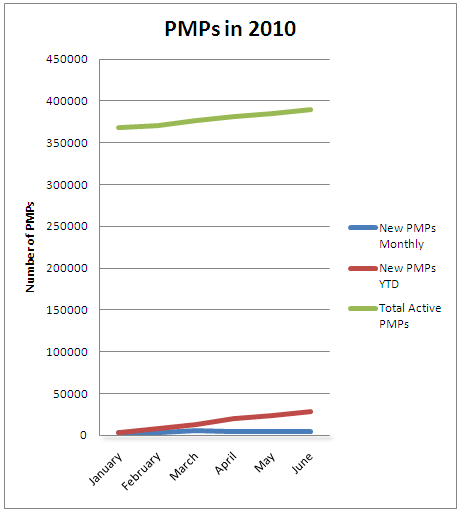
Every month I get a copy of PMI Today and I traditionally annotate 3 data points: New PMP® for the month, new PMPs year-to-date (YTD), and total number of active PMPs. I'm going to change what I'm reporting because PMI isn't providing YTD totals anymore.  I could calculate the number but it doesn't provide much additional value.  Instead, I'm going to start including the other credentials in other posts.  This post will be limited to the PMP counts.

The PMP certification rate dropped by almost 1,000 in July to 3,687.  There are now a total of 393,413 active PMPs.

The current trend predicts PMI will hit 400,000 active PMP credential holders before the PMI Global Conference in October.  You read it here first.  I bet there will be an announcement at the conference.

January February March April May June July
New PMPs (Overall) 3,714 3,713 5,344 4,718 3,985 4,630 3,687
Total Active PMPs 367,619 371,014 375,959 381,111 385,096 389,726 393,413

I want to congratulate those 3,687 out there who passed the exam in July.

Any comments about the current numbers?

Value Proposition for the Expensive Meeting

I got a lot of feedback from people after they read of my $17,902 meeting post.  I spoke to a few others in my office and they all agreed that the number sounded plausible. As I'm writing my proposal for corrective action, I will deliver it in the form of a value proposition. A value proposition is an analysis and quantified review of the benefits, costs and value that "something" an organization can deliver to customers and other constituent groups within and outside of the organization. It is also a positioning of value, where Value = Benefits / Cost (cost includes risk).  (Thank you Wikipedia for basis of that definition)

But, it's not as simple deliverable.

I use 7 stages of analysis.

  • Customer or market - Who am I creating the value proposition for?
  • Customer or market value - What do they say they value? (not what I say they value)
  • Offering - What is the product or service being proposed?
  • Benefits - What are the benefits? (Time, Money, Productivity,...)
  • Alternatives - What substitutes or alternatives are there? (like doing nothing)
  • Differentiation - How is my proposal different from anything else being offered?
  • Proof - What evidence do I have that I can do what you say?

In this case, I'm going to request a formal review of the Communications Plan, modifying it if necessary.  Because this is a status meeting (which is about reporting by one-way communication) not everyone needs to be there in person.  Before I go deep into my analysis, I'm going to bet I can apply the Pareto principle (80-20 rule) to get my point across.

If we do not devalue the benefit of the meeting, we can increase the overall value by decreasing cost.  That decreasing of cost, I would propose, would be asking 32 out of the 40 people to not attend the meeting in person.  By having 8 key linchpins (as defined by Seth Godin) attend this meeting, we could ensure the status is delivered and the message is not lost.

Other indirect communication methods could be used to ensure the information is distributed.  The slide deck and meeting minutes could be posted to a central location, allowing those who didn't attend the meeting in person to know what happened.  Whatever the final outcome, there is a big opportunity for cost savings.

Graphic: Pictofigo

Free High Quality Hand Drawings

While trying to locate some graphics for a recent blog post, I received a notification from Twitter that an account called Pictofigo had followed me.  Curious about who they were, I checked out the Pictofigo website. This was exactly what I was looking for!  Pictofigo provides high quality freehand drawings for project managers, presenters, and web designers in an easy and efficient way. It is 100% free but I would recommend making a donation to keep them motivated.  If I was an adviser to their organization, I would recommend they establish a paid tier and start charging for their product.  With just 172 drawings (graphics) in their database, I would love to see their product offerings grow.

The graphics remind me a lot of a very cool tool called Balsamiq.  You can use Balsamiq to create mockups of websites or applications.  I haven't personally used Balsamiq so maybe I'll contact them to see if I can do a review of their product.  In the meantime, you can go to Pictofigo now and get some graphics.

Graphic: Pictofigo