Brain eating Zombie PMs

zombie_eatmor

There are 3 things that spark my attention faster than anything.

1. Coffee

2. Zombies

3.

Damn ADD robbed me of my thought!

But I digress.

This morning, I read a blog post by Elizabeth Harrin titled Zombie Project Management. It reminded me of a series I read by Geoff Crane titled 9 Destructive Project Management Behaviors, which you can get for free by following the link. I really enjoyed her post and I hope you go over to her website and check it out.

Elizabeth wrote

So, what is Zombie PM? Does this sound like someone you know?

They do exactly what they are told without challenging anythingThey don’t come up with original ideasThey don’t suggest ways to improve the project management processesThey don’t follow up on actions – they simply assume they will get doneThey update and issue the plan in a format that most of the team can’t read or understandThey work on projects that deliver no business valueThey go through the motions of being a project manager but without any critical thinking applied

To answer Elizabeth's question, yes, I see these zombies every day. These zombies contribute to what is defined as the Iron Law of Bureaucracy. It states, in any bureaucratic organization there will be two kinds of people: those who work to further the actual goals of the organization, and those who work for the organization itself. One example in project management, would be PMs who work hard and look for ways to deliver value to the customer, versus PMs who work to protect any defined process (including those with no value). The Iron Law states that in ALL cases, the second type of person will always gain control of the organization, and will always write the rules under which the organization functions.

These zombies don't eat brains, they eat time and resources in the name of project management! So, sooner or later, zombies will take over your project. Be afraid. Be very afraid!
Principles Behind The Twitter Manifesto

We follow these principles: Our highest priority is to satisfy the follower through early and continuous delivery of valuable tweets.

Welcome a changing Twitter stream, even late in the day. Twitter processes harness change for the follower's informative advantage.

Deliver working links frequently, from a couple of hours to a couple of days, with a preference to the shorter timescale.

Tweeters and followers must work together continuously throughout the day.

Write tweets around motivated followers.  Give them the environment and support they need, and trust them to get the retweet done.

The most efficient and effective method of conveying information to and within the Twitter community is continuous conversation.

Reading informative tweets is the primary measure of progress.

Twitter processes promote sustainable tweeting and retweeting. The tweeters, followers, and twibes should be able to maintain a constant pace indefinitely.

Continuous attention to tweet excellence and good spelling enhances retweeting.

Simplicity--the art of maximizing the amount of letters not used--is essential.

The best blog posts, pics, and links emerge from self-organizing twibes.

At regular intervals, the twibe reflects on how to become more effective, then tunes and adjusts its behavior accordingly.

Thank you to the authors of the Agile Manifesto.  Without it, my life would have less direction and this post would have even less value.

Graphic: Pictofigo

5 Twitter Retweet Rules

I spend a lot of time online, perhaps too much.  I read blogs and tweets and engage people wherever and whenever I can.  Using all of these methods of communications is not necessarily for me to just spout project management doctrine.  I look to share ideas to better myself and hopefully make life a little easier for others. It doesn't matter if it's a lifehack, a web app, or discovering a blog.  There is a lot of cool stuff out there and every day I find and learn something new.

Once in a while something does rub me the wrong way.  It might be someone trying to pick a fight in the blog comments or maybe it's someone flooding my Twitter stream with noise.  This weekend it was too little sleep in combination with too much Twitter noise.

As many Twitter users know, the more followers you get, the louder your megaphone.  To counter that, the more people you follow, the louder the noise.  The noise can sometimes be deafening.

I usually see the same topic cycle through my Twitter stream 4 or 5 times before I finally click on it.  What I like about this process is that it's organic.  The link seems to increase in value the more people I listen to tweet about it.  Once it hits critical mass in my head, I check it out.

So, what's the rub?

This weekend, I had over half a dozen people tweet the exact same thing at the same time.  My Twitter feed was momentarily flooded by people who subscribed to a website.  Rather than having people I follow retweeting the link organically, the site sent out the tweet.  That feature deprecated the value rather than increasing it.  Though we all may be fighting for positions in the stream, hoping someone will hear us, I like to follow a few simple rules.

My Twitter Retweet Rules

  1. If you read something notable and it provides value, retweet it
  2. If you read something that is not notable or does not provide value, do not retweet it
  3. If someone I trust and respect tweets something, I see value
  4. If more people I trust and respect retweet the link, I see even more value
  5. If several people tweet the exact same thing at the exact same time, all value is deprecated

Graphic: Pictofigo

The Funnel Effect and My Kanban

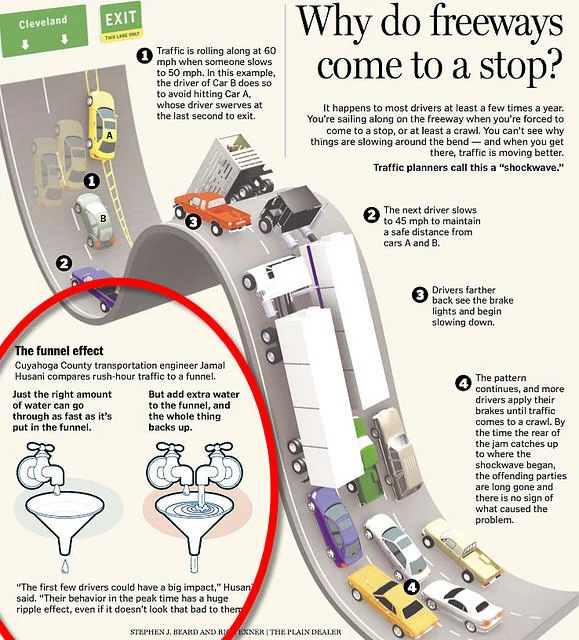
GuyKawasaki tweeted about a really cool infographic on Alltop titled Why freeways come to a stop. I checked it out and what most interested me was the graphic The funnel effect (I circled it in red).

WIP

WIP

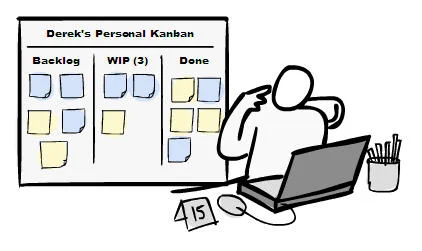
The funnel effect is a really good analogy of why you should limit your work in progress, like I do on my Personal Kanban.  In the analogy, just the right amount of water can go through as fast as it's put into the funnel.  But add extra water to the funnel, and the whole thing backs up.

Personal Kanban

Personal Kanban

In reality, keeping focus on just the right amount of work can allow you to finish more than if you didn't. Personally, I limit my work in progress to 3 items. I never thought it would have such a positive impact. So, what do you have to lose? Do you have a long list of to-do's, doing a little here and doing a little there?  Do you ever feel like you're not actually getting anything done?  Today, rather than trying to multitask, focus on just a few tasks until they are DONE. If you complete one task, you can add another to your focus list. Remember, 99% done is still not done.  At the end of the day, you'll feel a sense of accomplishment, preventing a traffic jam of work and actually getting stuff done.

The Story of Monte Carlo

Monte CarloOnce upon a weekday meeting, I had a story to tell.  It was the tale of a project manager, who’s name really rings a bell. He quantified the total project cost, he didn’t miss a dime. He also computed the schedule, he was always aware of the time.

He used all these input values, with random amounts being his friend. He ran these simulations.  I thought they would never end.

The outcome was a distribution, a bell curve if you like.  On the edges we saw some low points, in the middle there was a spike.

Monte Carlo was this fellow’s name, he was a heck of a numbers guy.  We asked him if he ever made things up.  He said he would merely quantify.

Now don’t think Monte worked alone, he had a counterpart.  Her name was Jane Stake-Holder, he worked with her from the start.

Jane could be quite demanding, sometimes ignoring project scope.  But Monte managed the situation well, knowing creep was a slippery slope.

His technique was well documented, a change would make everything slip.  He told this to Jane Stake-Holder who you'd think would do a back-flip.

But numbers don't lie and neither did he, Jane knew Monte would put up a fight.  She backed down and submitted a change request, the schedule would extend to the right.

Graphic: Pictofigo

A Critical Path Facelift

The Critical PathAfter having the same look on my website for over 2 years, I think it's time for a facelift.  So, if you come to the site within the next week and notice things looking a little different, don't fret!  In addition to the frontend changes, I plan to move the site over to PowerVPS (Virtacore Systems), who hosts my other sites.  So, grab yourself a fresh cup of coffee (or tea) and continue enjoying my rants and insights. If you think the graphic above looks a little like me drawing a Critical Path, you should go to Pictofigo and check out their other offerings.  Thank you again to Pictofigo for doing such an awesome job!

Regards,

Derek

Warning – Use of PM Force Authorized

We went to an airshow this last weekend. Being I was in the Marines some 20+ years ago and spent the best of my time in the air in a helicopter, it was like a trip down memory lane. I loved the smells and sounds of the flightline. I even got to walk onto a CH-53.  It was the first time since May 09, 1990.  But I digress. Upon arriving at the airshow, I noticed a warning was painted on the flightline that made me clap my hands like a cymbal-banging monkey. My wife took a picture so I could somehow relate it to project management in a future blog post.

Here is my Project Management translation:

WARNING

Efficiently Managed Project

It is unacceptable to do work on this project without motivated individuals. Give them the environment and support they need, and trust them to get the job done.

Principle 5 Agile Manifesto of 2001 - February 11-13

While on this project all team members and the work under their control are subject to refinement.

USE OF PROJECT MANAGEMENT FORCE AUTHORIZED

The Iron Law of Bureaucracy versus ICAgile

Agile

I was listening to This Week in Tech #264  and one of the guests was Jerry Pournelle. Though it's not necessary to go into the details of the NetCast, Jerry said something that had me scrambling for the rewind button.  He referred to his Iron Law of Bureaucracy. (Jerry) Pournelle'sIronLaw of Bureaucracy states that in any bureaucratic organization there will be two kinds of people: those who work to further the actual goals of the organization, and those who work for the organization itself. One example in education would be teachers who work and sacrifice to teach children, versus union representatives who work to protect any teacher (including the most incompetent). The IronLaw states that in ALL cases, the second type of person will always gain control of the organization, and will always write the rules under which the organization functions.

I then watched a Ted Talk titled The Child-Driven Education.  There were three statements by Sugata Mitra that I want to reference.

  1. Self-organizing system: Is where the system structure appears without explicit intervention from outside the system.

  2. Emergence: The appearance of a property not previously observed as a functional characteristic of the system.

  3. Speculation: Education is a self-organizing system, where learning is an emergent phenomenon.

So, what does this have to do with Project Management?  The organizational machine that is the Project Management certification ecosystem has become that second group Jerry Pournelle identifies.  There is now an entire industry dedicated to certifying people and keeping them certified, including the most incompetent. There is no focus on educating people in best practices, delivering value to customers, or increasing project success rates.

On the other end of the spectrum are the visionaries, the mentors, and coaches.  This is where I make my speculation.

Keep your eyes on the International Consortium of Agile (ICAgile).  At ICAgile, the certification path is divided into three main phases; a Fundamentals Phase, a Focus Track Phase, and a Certification Phase.  It's not all about getting certifications.  It's about educating and learning.  In the Fundamentals Phase, the goal is to educate the attendee with the values, principles and basic practices of Agile.  Having garnered the fundamentals of agile in the first phase, The Focus Track Development phase will have different tracks to choose from.  This will allow people to focus being educated in different functional areas like Project Management, Business Analysis, and Testing. Only after completing the courses in a focus track, will the applicant is eligible for the ICAgile "Professional" certificate.

I'm very bullish on ICAgile educating and people learning.

Being Agile is self-organizing by nature, does ICAgile have the unique opportunity to prove the Iron Law of Bureaucracy wrong?

Graphic: Pictofigo