Pomodora Relationship

I have a dirty little secret.  I have an on-again off-again love affair with the Pomodoro technique.  Though I deal with a wicked case of ADD, I seem to keep it in check, thanks in part to my Personal Kanban.  The other method I use, though I admit not as commonly, is a pomodoro timer.  When things get really bad, I break out the timer.  And ya know, things get back on track!  You'd think I would learn. If you find yourself reading this blog, you'll find that I'm a proponent of  using simple techniques to get things done.  If you're looking for me to do a deep dive on policy, process, and procedure, you're in the wrong place.

So, how do I get some of my work done?  [1] I limit my work in progress (WIP) and [2] I limit my time (timebox). When I do both, I tend to stay focused and deliver more. The pomodoro technique, like other techniques I like, is pretty darned simple.

So, let's talk about my Piggy Pomodoro!

  1. Choose a task to be accomplished
  2. Set the Pomodoro to 25 minutes (the Pomodoro is the timer)
  3. Work on the task until the Pomodoro rings, annotate the task you were working on
  4. Take a short break (I take 5 minutes)
  5. Every 4 Pomodoros take a longer break (I take 10 minutes)

As part of this process, I'm moving tasks on my Kanban from Backlog to Work in Progress.  If I take a break, I move it to Blocked.  When I return, I move it back to Work in Progress.  This allows me to visualize what I'm working on and know what I was working on before my break.

Have a Kanban or Pomodoro story?  I would love to hear it.

Why do I use a Piggy, you ask?  Because tomatoes give me gas and Chickens would just be wrong.

Image:  Amazon

The Cave of Zombies

zombie_eatmor

The “Allegory of the Cave” by Plato represents an extended metaphor that is to contrast the way in which we perceive and believe is reality. Plato said what we see are actually imperfect “reflections” of the ultimate Forms, which represent reality and truth.  In his story, there is a cave in which prisoners are chained down and forced to look at the front wall of the cave.  Behind the prisoners is a fire and puppeteers, casting shadows on the wall in which the prisoners perceive as reality.  Being you and I know there are puppeteers, we know the shadows the prisoners are seeing are not reality.  But, it's their reality, none the less. Once a prisoner is released, he is forced to look at the fire and objects that once provided his perception of reality.  Only then does he realize these new images in front of him are now the accepted forms of reality. Plato described the vision of the real truth to be “aching” to the eyes of the prisoners. He added they would naturally want to go back to the cave and look at what they had always seen as a pleasant and painless acceptance of truth.

Once a prisoner climbs out of the cave and is fully immersed in the rays of the sun, the prisoner would suffer bewilderment, fear, and blindness to the objects he was now being told were real. The natural reaction of the prisoner would be to recognize shadows and reflections. After his eyes adjust to the sunlight, he begins to see things as they really are.

Plato's allegory made me think about zombies. Oh hell, what doesn't!?

We're not just prisoners in a cave, we're zombies.  Those who have left the cave come to visit once in a while.  They may complain that the food outside isn't as good.  But, they've taken the uncomfortable step of leaving the cave and merely want you to eat something other than brains.  If you are a zombie still in the cave, the other zombies are going to tell you to just eat more brains.

It doesn't matter what kind of zombie you are.  If someone offers to expand your reality with ideas foreign to your own, don't be so negative.  Don't just dismiss them. Don't eat more brains.

Like the image?  Find them at Pictofigo

Is Santa Agile?

Tony Askey of Post-it Projects asked  "[Are] Santa's elves using Kanban in the toy shop!!?? I can see it happening.  But doesn't it sound a little disturbing hearing about Santa controlling his WIP?  What are the elf labor laws like at the North Pole?

Brian Bozzuto at Big Visible asks, does Santa draft his "naughty and nice" list up front and implement change control or is he Agile?

I hummed a few bars and thought "Making a List, Checking It Twice..."  My answer: Santa isn't necessarily using any kind of Agile process for this.  I do think it's a draft.  He created the (draft) list, it's tested.  Since the song says he does it twice, perhaps he is doing both a unit test & acceptance test.  Once the list is baselined, I bet he does use change control.

Brian's response was then: If he's checking his list twice, why doesn't he automate?

Oh man, I think Brian has just stumbled onto something.  If Santa isn't using automated tests, I bet he's delivering a lot more presents to kids who should be getting coal.  I think the automated test scripts should be ran daily, right up to deployment.  Even if Santa is not doing automated testing, he should be leveraging some kind of automated deployment. Seriously, you think Santa should delpoy all of those toys around the world in one night without some kind of automation?

Though you don't think "Lean" when you think Santa, the guy has be to be leveraging some kind of Agile processes.

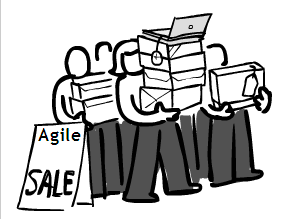
Agile Shopping List

I was over at the AgileScout website and found a humorous post. The title was Agile Products for Sale - What's Worth Buying. Eric Laramée from Agile Partnership made a comment and got me thinking.  Why aren't more retailers jumping on the bandwagon to offer "Agile" products?

What got us started was a listing on Amazon for a ($12.50) pack of 50 pack of Story Cards. Now, I'm not going to say anything bad about this product. I actually think it's clever they are offering a product like this.  Those who have been doing Agile for more than one iteration probably have multiple packs of ($1.95) 100 pack 3x5 index cards sitting on their desks.

In no particular order, here is a list of "Agile" products I found on Amazon.  Yes, all of these links are going to an Amazon affiliate account.  I figured I would give it a try.

Agile Shopping List

Not on Amazon, are Mountain Goat Software planning poker cards.  What can I say, I love these cards.

So, what's on your Agile shopping list?  Feel free to add a comment.

Like the image?  Find them at Pictofigo

Know Your Customer

Communications with your customer(s) and team(s) is key to your success.  Knowing what they want is just as important as what you plan to deliver.  I laughed out loud (uncomfortably) when I saw the graphic to the left.  Though I'm not Jewish, I've worked with a lot of people from around the world.  I've grown to appreciate the things that make us all unique.  Trying to sell some Jews a ham on Chanukah is almost as bad as offering an all-you-can-eat meat buffet to a vegetarian.  It doesn't matter how good of a deal you can offer, the product itself must meet the needs (and wants) of the customer.  Perhaps if the vendor of the boneless smoked ham had the list below, they could have avoided this embarrassing (and potentially costly) situation. Problem Statement

Describe the business reason(s) for initiating the project or building a product, specifically stating the business problem.  Identify the high level goal it relates to.

Description

Describe the approach the project or product will use to address the business problem.

Goals and Objectives

Describe the business goals and objectives of the project or product. (I like user stories)

Scope

Describe the project or product scope. The scope defines limits and identifies what is delivered (inclusive). The scope establishes boundaries and should describe products and/or services that are outside of the scope (exclusive).

Critical Success Factors (Acceptance Criteria)

Describe the factors or characteristics that are deemed critical to the success of a project or product, such that, in their absence the it will fail.

Assumptions

Describe any assumptions related to business, technology, resources, scope, expectations, or schedules.

Constraints

Describe any constraints being imposed in areas such as schedule, budget, resources, products to be reused, technology to be employed, products to be acquired, and interfaces to other products. List the constraints based on the current knowledge today.

I want to thank my wife for sending me the image.

Agile Traffic Analogy

The post today was brought to you by... my hellish commute and those in the Washington DC metropolitan area who help create it.  Thanks! Today, I'm going describe Agile concepts by using my commute as the analogy.

Goal

During any given day, spend as much time working or at home and as little time commuting as possible.

I'll write a User Story because I'm weird like that

As a project management advisor to a government PMO, I want to travel 55 miles in the shortest period of time so I can spend more of my life delivering value than wasting time sitting in traffic.

Predictive Approach

How long will it take to drive 55 miles to the office in the morning and 55 miles to my home in the evening?  We've all had to estimate our commute time.  Sucks, doesn't it!?  We're all terrible at estimating.  Why?  Things change...constantly!  You can spend as much time and energy as you want, trying to think of all of the possible scenarios.  You can break your commute into "chunks" and estimate those.  That could give you a better estimate, taking into account variances in each leg of the commute.  But, until you get on the road and actually start your commute, you just don't know.  We've got weather we need to deal with.  We've got that knucklehead in the far left lane, driving 10MPH under the posted speed limit (with his blinker on).  We have to deal with the occasional traffic accident.  Work on a project is no different.  You can try to estimate your time, up front, but when something happens (notice I wrote WHEN not IF) your original estimate is going to be wrong.  What are you going to do?  Are you going to try to make up the lost time later in your commute?  Is something else going to be sacrificed like hours of work or hours at home?

Do I personally think there is a more accurate way to estimate a commute, as the commute happens?  Yes.

Adaptive Approach

This was my Adaptive commute this morning.  My wife told me that the traffic report on the radio stated there was an accident 40 miles into my commute.   Good to know, I thought.  Information is good.  Communications is good.  So, did I change my estimate at that time.  Nope!  Why, you ask?  I was armed with my handy Droid X.  My Droid X has GPS and Google Maps with a traffic overlay.  Now, I still broke my commute down into chunks.  I still had the basis of estimate there.  But, the magic happened after the commute began.  I did see the traffic slow down (on the map) that my wife referred to.  But, the radio was still reporting that the lanes were blocked.  The map indicated that traffic was getting by slowly.  Good to know I thought.  Information is good.  Communications is good.  But now, I saw (on the map) that traffic was stopped much earlier and they were not saying anything on the radio traffic report.  By the way, the radio station only reports the traffic every 10 minutes.  By getting realtime feedback from the Droid, I was able to know when I was going to have take a different route, to bypass the delay. I took the next exit and my commute route and the map refreshed.  I could see, by the map, where I could get back onto my original route.  I actually arrived to the office, 20 minutes from my optimum commute time.  If I had not had the Droid and the constant feedback about the traffic conditions, it would have added a hour.

I still lost 20 minutes.  But that was unavoidable.  But I think I minimized my delays by getting real-time feedback.  I had opportunities to adjust my course based on information.  I was able to adjust my commute estimate every minute, not every 10 or 20 minutes.  If someone from the PMO had called me to ask when I was going to get to the office, at any time along my commute, I could have given them a pretty good estimate.  But that telephone call isn't necessary.  Here comes the kicker.  I share my location with Google Latitude.  They can see where I am at any time.

Here are some things to think about for your next commute

  • Know where you are and where you want to go
  • Break your commute into chucks
  • Get traffic conditions as often as possible
  • Be prepared to change direction
  • Be prepared to reestimate your time of arrival, the closer you get to your destination
  • Give people a way to know your location so they don't have to ask you every 5 minutes
  • Feedback is good
  • Information is good
  • Communications is good

Like the image? Find them at Pictofigo

Zombie Culture

How do you refer to your company or team culture?  Do you refer to yourself and your immediate team as "we" or "us" and to your company or extended team as "they" or "them"?  If you do, do you think this is a problem?  I do. For arguments sake, let's refer to you as a non-zombie and we'll refer to your extended team or company as the potential zombies.

Though it was fun back in the 5th grade to play a game of tug of war with your classmates, it's not so cool when you're working in a corporate environment.  Projects can be challenging enough.  You shouldn't have to be distracted by other groups who don't have the same high level goals or values as yourself.  You should be working as a team in order to be successful.  But, does your team or company have clearly defined goals or values?  I'll ask it a different way.  Does your team or company have them written down; you know what they are; and you know what they mean?  If not, you and your group are at risk of being part of the zombie culture.

Zombie culture is a lot more common than you might think.  Zombies have no specific goals, other than to eat your brain.  They're not trying to make you a zombie.  Becoming a zombie is merely a byproduct to having been bitten by the undead.  They really don't care.

I've said before, don't do something unless it's applicable to meeting a goal.  But I bet you're asking yourself right about now, "Derek, if my coworker doesn't smell like rotting flesh or isn't squatting in a corner knawing on a foot, how do I know they are a zombie?"  I've compiled a list of a few indicators of zombie culture.

Zombie Culture Indicators

  • Hosts meetings...long meetings... several of them...with no agenda... with several invitees.
  • Stops by your desk a lot to ask what'cha doin'?
  • Withholds information for personal gain
  • Just shows up for work and thinks they are doing you a favor
  • Farts (Actually, thinking of a farting zombie made me laugh so I thought I would add it)
  • Uses the "cc" email feature by default, when the recipient has nothing to do with the conversation
  • Uses the "reply-all" email feature to continue conversations that don't pertain to the group
  • Is disrespectful
  • Is untrustworthy (with throw you under a bus)
  • Does not lead by example
  • Tries to impress everyone by how smart they are. (that's a more advanced zombie type)

I can go on and on but I really don't like negative posts.  Let's turn this around.  What values can you and your team have that will have zombies avoiding you like the perfume department of the local Macy's department store?

Values to Repel Zombie Culture

  • Deliver WOW Through Service
  • Embrace and Drive Change
  • Create Fun and A Little Weirdness
  • Be Adventurous, Creative, and Open-Minded
  • Pursue Growth and Learning
  • Build Open and Honest Relationships With Communication
  • Build a Positive Team and Family Spirit
  • Do More With Less
  • Be Passionate and Determined
  • Expect to deliver the extraordinary
  • Treat others with respect
  • Promote collaboration and teamwork
  • Encourage creativity and risk-taking
  • Make and meet our commitments
  • Trust and support one another
  • Be Humble

I'm going to admit, I didn't think up those awesome zombie-repelling values.  I got them from Zappos and VersionOne. I'm going to go out on a limb and say I don't think either of those organizations have zombie cultures.  Can you say the same for yours?

Like the image?  Find them at Pictofigo

PMI Statistics

october_pmi_stats

The October Project Management Institute (PMI) statistics are in.  The PMI now has over 403,220 active Project Management Professionals (PMPs) and 330,001 members. Source: PMI Today

When I look at the data from the last 4 years, the PMP® credential trend has remained relatively consistent.  Additionally, the PMI membership trend has also remained relatively consistent.  Unfortunately, based on the data, it appears people value the PMP credential more than they do being a PMI member.  Why is that?

Congratulations to all of those who reached their goal to obtain the credential.  (When I was at the PMI North American Congress back in October, they were quick to point out that the PMP is not a certification.  It's a credential.)  I don't know if anyone out there is really making a big deal about that.

Jan

Feb

Mar

Apr

May

Jun

Jul

Aug

Sep

Oct

New PMPs (Net)

3,714

3,713

5,344

4,718

3,985

4,630

3,687

3,965

2,681

3,161

Total Active PMPs

367,619

371,014

375,959

381,111

385,096

389,726

393,413

397,378

400,059

403,220